How do you get out of task paralysis?
Name what is actually in the way, shrink the task to one physical first step you could finish in two minutes, and start a visible timer; stopping when it ends still counts. The freeze usually isn't about the whole task. It's about the first unpleasant minute, and a 2007 meta-analysis of procrastination research found task aversiveness among its strongest, most consistent predictors.
You don't need to want the task. You need a first step small enough not to argue with.
The whole flowchart, written out
Same logic as the tool above, in text, so you can screenshot it. Start at the top and stop at the first "yes".
- Do you know what the first physical action is? No: break the task into 2 to 5 steps and take the first. Yes: keep going.
- Does that first action still feel too big? Yes: make it smaller until it would take under two minutes. "Reply to the landlord" becomes "open the email".
- Is your head too noisy to hold the task? Yes: write everything down first, then come back and pick one thing.
- Are you blocked by someone or something else? Yes: park it as Waiting and choose a different task. Not every freeze is yours to fix.
- Are you running on empty? Yes: take a break with an end time, or pick the version of the task you could do tired.
- None of the above? Start a two-minute timer on the first step. When it ends, decide again.
Ways out of a freeze, compared
| Approach | First action | Asks you to commit to | Good when |
|---|---|---|---|
| Two-minute start | Within a minute | Two minutes | The start is the hard part |
| 25-minute focus block | Within a minute | 25 minutes | You're already moving |
| Rewriting the to-do list | Feels immediate | Nothing, really | Rarely, honestly |
| Waiting to feel ready | Unknown | Hope | Deadlines are far away |
Our framing, not a study. The two-minute start and 25-minute timers are both in Now; you can switch after the ring ends.
A mini story: the tax envelope
It's been on the counter since October. Every time you look at it, the whole job arrives at once: forms, logins, that one missing receipt. So you tap "It feels too big". The tiniest version: open the envelope and put the pages in a pile. Two minutes. The ring runs out with the pages sorted into three piles, and you notice you've already read the first one. You keep going for ten more, or you don't. Either way, the envelope is open.
Who this flowchart is not for
If the freeze comes with low mood that lasts for weeks, or you've stopped doing things you used to enjoy, a timer isn't the answer; a clinician is. This is general information, not medical advice. Talk to your clinician.
If you manage big projects with dependencies, you need a project tool. Now holds one task at a time on purpose.
If you start fine but can't stop, a starter won't help much; a blocker or a hard end time will.
Honest limits
- Now is a productivity-support tool. It doesn't diagnose, treat or manage ADHD or any condition.
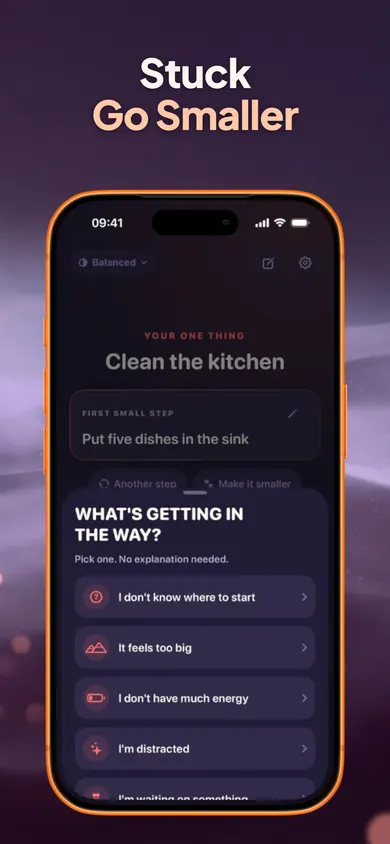
- The Stuck button gives you one practical move. It can't make an unpleasant task pleasant; it only makes the start smaller.
- Routines and full Time Mirror history are Now Pro ($4.99 a month, $29.99 a year or $59.99 once, US prices). The flowchart above, the Stuck button and the two-minute ring are free.
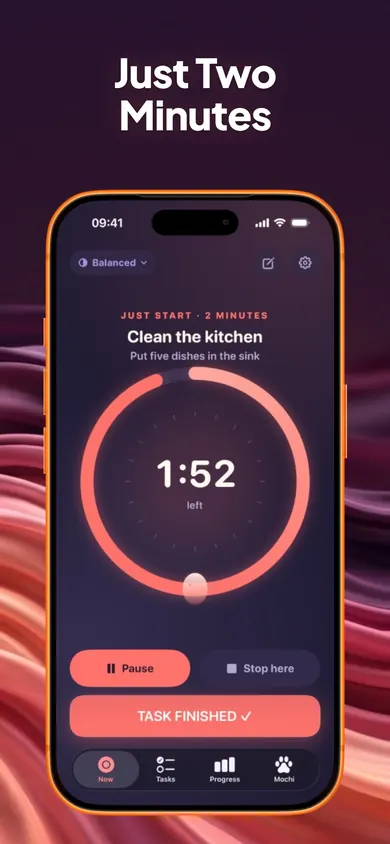
- One design decision we made: when you end the two-minute ring early, it still counts as a start. Punishing an early stop teaches you not to begin.
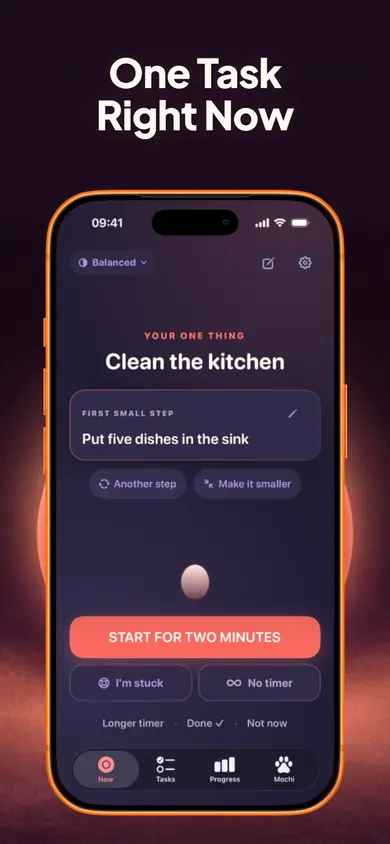
Proof: the flowchart inside Now
Task paralysis questions
What is task paralysis?
An everyday name, not a diagnosis, for freezing in front of a task you mean to do. You know what needs doing, but the start won't come. Many people with ADHD describe it, and plenty of people without ADHD do too.
Is task paralysis an ADHD symptom?
"Task paralysis" isn't a clinical term. The NIMH describes inattention in ADHD as having difficulty paying attention, keeping on task or staying organized, and notes it's common for people to show these behaviors some of the time. Only a clinician can assess ADHD.
Why do some tasks freeze me more than others?
Unpleasant tasks are a big factor. A 2007 meta-analysis in Psychological Bulletin found task aversiveness was one of the strong, consistent predictors of procrastination. That's why shrinking the first step helps: it makes the start less unpleasant.
Does a two-minute timer really help?
It gives you a start with a visible end. In Now, the two-minute ring can be paused, stopped early or extended, and ending early still counts, so the start doesn't become a promise to finish.
What if I'm frozen because I'm exhausted?
Then the right move may be a timed break, not a push. Now's Stuck button includes "I don't have much energy" and "I need a break" for exactly that. If exhaustion or low mood lasts for weeks, talk to a clinician.
Is Now free?
Yes for the core: the one-task screen, two-minute starter, Stuck button, task breakdown, Brain Dump, focus timers, daily plan and Quiet Mode are free forever. Now Pro adds routines, full Time Mirror history and CSV export.
Start on your iPhone
One task, one small step, two minutes. Get Now free on the App Store.

Updated November 2026
Related
- ADHD New Year resolutions: six myths to drop before January 1, 2027New Year resolutions with ADHD don't need more willpower. Six myths checked against research, plus a 5-item ring checklist for Fri 1 Jan 2027.
- Now: one task, one small step, two minutesNow shows one task, one concrete first step and a two-minute timer. Tap I'm stuck to go smaller. Free on iPhone, no account.
- Why can't I start tasks I want to do?Wanting to do it and starting it are different skills. Tap what's in your way for one next move, then read 12 straight answers. No account needed.
- Overwhelmed by your to-do list? 5 apps comparedNow, Goblin Tools, Llama Life, Tiimo and Structured, checked against their App Store listings in Nov 2026. Tap your kind of overwhelm to see which fits.