Myth Resolutions never work, so why bother.
Fact In a 2020 study of 1,066 people, 55% of those who answered the one-year follow-up considered themselves successful in sustaining their resolutions.
For anyone who finds starting hard
A five-item check before January 1, built around one tiny first step.
0of 5 ready
 Free on iPhone
Make one resolution, phrase it as something to do rather than something to stop, attach it to a moment ("after dinner, I will...") and shrink the first step until it takes two minutes. That isn't a special ADHD rulebook; it's what the research on resolutions and if-then planning points to, and it happens to suit brains that find starting hard. New Year's Day 2027 is a Friday, so you have a weekend to practise.
You don't need a bigger resolution. You need a smaller first step.
Myth Resolutions never work, so why bother.
Fact In a 2020 study of 1,066 people, 55% of those who answered the one-year follow-up considered themselves successful in sustaining their resolutions.
Myth "Stop doing X" is the strongest kind of resolution.
Fact The same study found approach-oriented goals (do more of something) succeeded more often than avoidance goals (stop something): 58.9% vs 47.1%.
Myth You have to do it alone, on willpower.
Fact In that study, the group given some support was significantly more successful than the others. A plan, a person or a tool all count as support.
Myth A good intention is enough.
Fact A 2006 meta-analysis of 94 tests found that if-then plans ("when X happens, I will do Y") had a medium-to-large effect on reaching goals, d = .65.
Myth Bigger resolutions are more motivating.
Fact Unpleasant-feeling tasks get put off: a 2007 meta-analysis found task aversiveness among the strongest predictors of procrastination. Big and vague is a recipe for aversive.
Myth Trouble starting means you don't really want it.
Fact The NIMH describes ADHD inattention as difficulty paying attention, keeping on task or staying organized. Friction at the start says nothing about how much you care.
If you already have a system that works, keep it. A new app in January is its own kind of resolution.
If you want a planner with projects, deadlines and calendars, Now will feel bare. It shows one task, one step and one timer, on purpose.
If you're unsure whether ADHD is part of the picture, a clinician can help you find out; no app or checklist can. This is general information, not medical advice. Talk to your clinician.
January 2026: "Get organised, exercise, read more, stop doomscrolling." Four resolutions, all big, two of them "stops". By the 9th, none had a first step, so none had a start.
January 2027: one resolution, "read before bed". The if-then: after brushing teeth, I open the book. The two-minute version: read one page. Some nights it's one page. Some nights it's thirty. Every night it starts.
Ones you can start in two minutes and phrase as something to do: "put five dishes in the sink after dinner" rather than "stop letting the kitchen get messy". In a 2020 PLOS ONE study, approach-oriented resolutions succeeded more often than avoidance-oriented ones.
Often better than their reputation. In the same study of 1,066 people, 55% of those who responded at the one-year follow-up considered themselves successful in sustaining their resolutions.
We'd say one. Research doesn't give a magic number, but every extra resolution is another thing to start, and starting is usually the hard part.
Then you start the next day. Nothing about a resolution resets unless you decide it does. In Now, unfinished tasks never pile onto tomorrow, and Mochi, the optional companion, is never sad.
Now is built for anyone who finds starting hard, including many people with ADHD. It's a productivity-support tool. It doesn't diagnose, treat or manage ADHD or any medical condition.
The core is free forever: the one-task screen, the two-minute starter, the Stuck button, Brain Dump, focus timers, the daily plan and Quiet Mode. Now Pro adds routines, full Time Mirror history and CSV export.
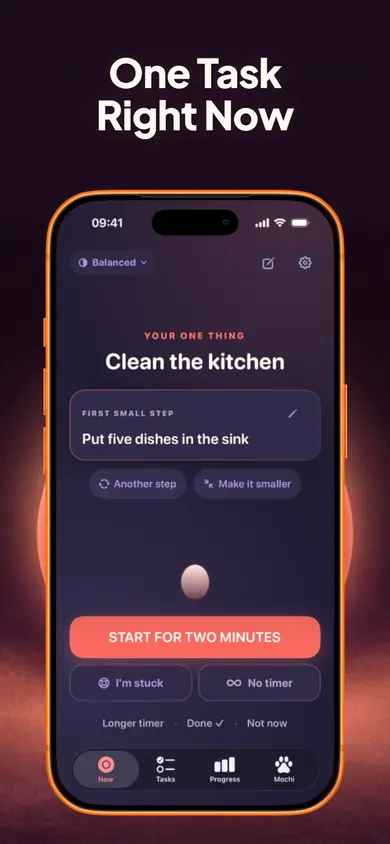
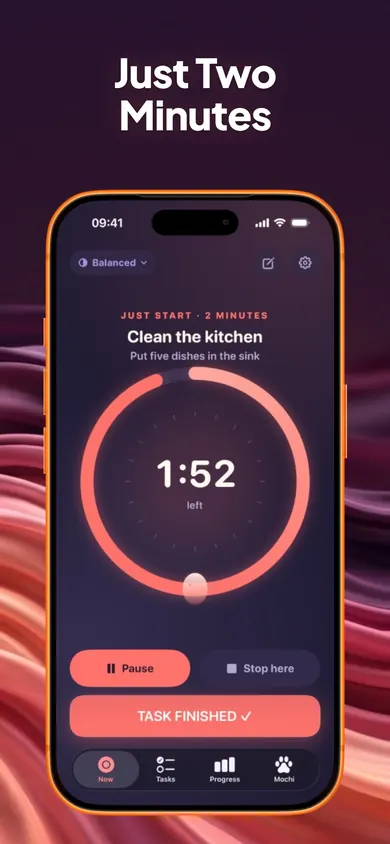
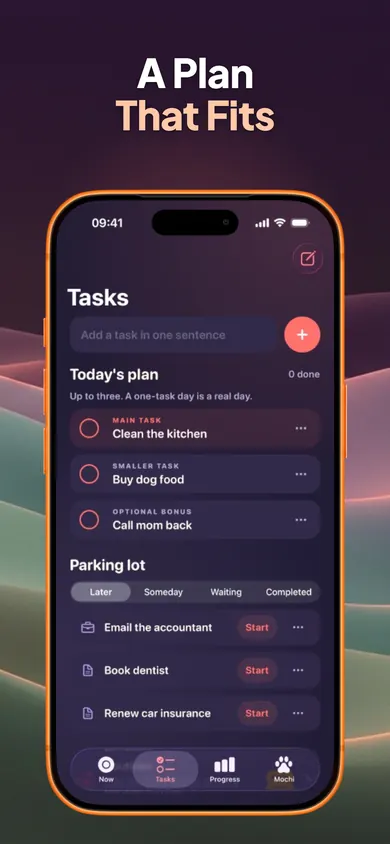
Honest limit: routines, the natural home for a daily resolution, are part of Now Pro ($4.99 a month, $29.99 a year or $59.99 once, US prices). The task screen, the ring and the Stuck button are free. One design decision we made: the daily plan holds three tasks at most, because a fourth is usually where January goes wrong.
Pick the resolution tonight; start it on Friday 1 January. Get Now free on the App Store.
Updated November 2026