Why can't I start tasks I want to do?
Because wanting the result and starting the task are different skills: the start is often unclear, too big, or up against something easier, and wanting it does not change any of that. The fix is rarely more willpower. It is a smaller, clearer first step and a short window to take it in.
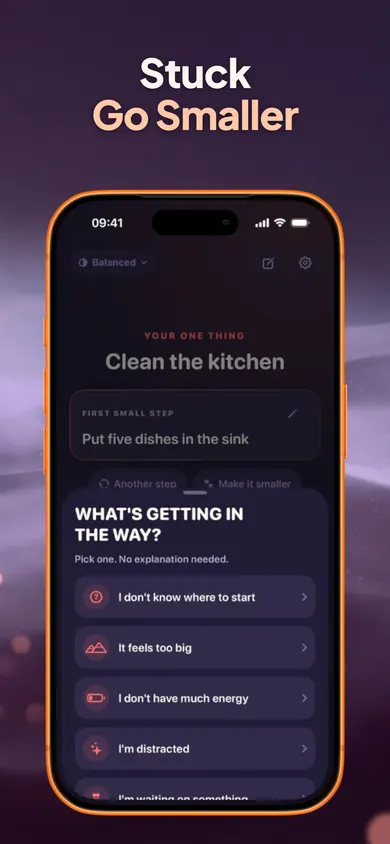
The six buttons above are the same six reasons Now's "I'm stuck" button offers. Each one has a different next move, which is why one-size advice like "just do it" bounces off.
Wanting it is not the same as being able to start it.
Proof: what the unstick looks like in Now
A mini story: the guitar in the corner
He bought the guitar in March. He wants to play it; that part is real. Every evening the plan is "practice tonight", and every evening it loses to the sofa. Not because he does not care, but because "practice" means tuning, finding the tab, deciding what to learn, and doing it all well.
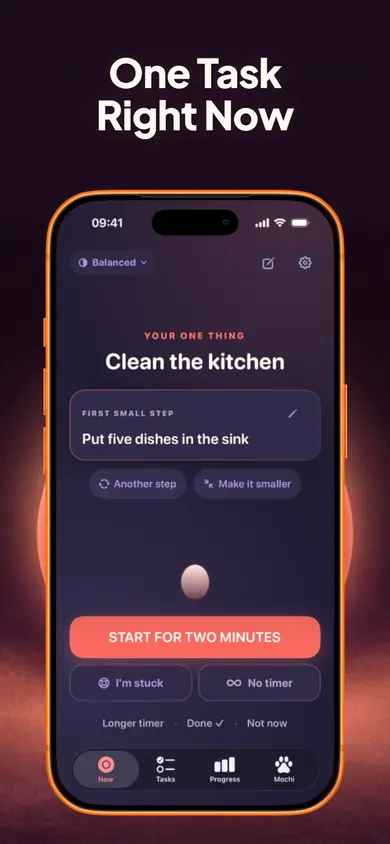
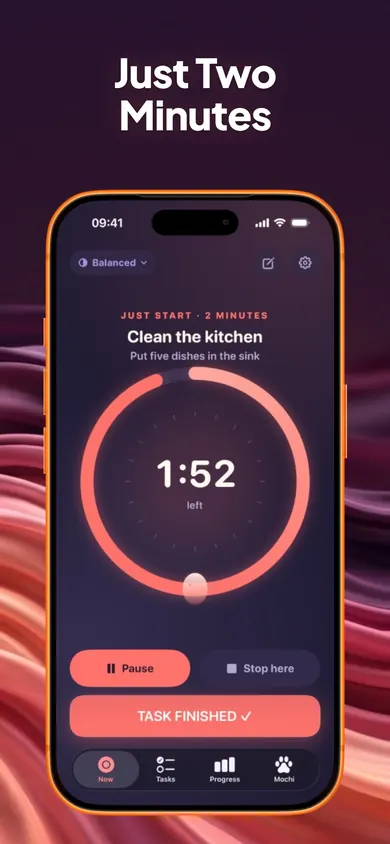
The Stuck button says I don't know where to start. The next move: one physical step. "Take the guitar off the stand and tune the low E." Two-minute timer. He tunes all six strings, plays one chord badly, and the timer ends. He keeps going for 18 minutes. Tomorrow's first step is already obvious.
A scenario we wrote, not a user story.
More questions about starting things you want to do
Why can I do things for other people but not for myself?
Other people bring a deadline, a clear request and someone waiting. Your own projects bring none of those. Borrow the structure: one named first step, a short timer, and a time you will start.
Why do I avoid things I'm excited about?
Excitement raises the stakes. If the project matters, the first attempt has to be good, so it waits for a better day. A two-minute start lowers the bar back down to "begin badly".
Is it laziness?
Lazy would mean not wanting to. You do want to, which is the confusing part. Stuck is a better word, and stuck has specific causes you can name and work on.
When should I talk to someone about it?
If getting started is hard across most of your life, for a long time, and it is costing you at work, school or home, talk to a clinician. For context, the National Institute of Mental Health (page reviewed August 2026) describes ADHD inattention as difficulty paying attention, keeping on task or staying organized. A clinician can tell you what fits; an app cannot.
Ways people try to start, compared
| Approach | What it asks of you | Where it stalls |
|---|---|---|
| Wait to feel like it | Nothing, until the mood arrives | The mood rarely arrives first |
| A long to-do list | Choose from 30 items | Choosing is its own task |
| A 25-minute block | Commit to 25 minutes up front | 25 minutes feels big at the start |
| Now's two-minute start | One step, two minutes | It helps you start; finishing is still up to you |
Honest limits
- Now helps with starting, not with everything after. Long projects still need planning, and Now holds one task on screen at a time on purpose.
- It is not treatment. Now does not diagnose, treat or manage ADHD or any medical condition.
- Some parts are Pro: routines, full Time Mirror history and insights, full history with CSV export, and premium Mochi customization.
- One design decision: unfinished tasks never pile onto tomorrow. A list that grows overnight makes the next start harder.
- Pick something else if you want a visual day planner or a shared family calendar; Now is deliberately smaller than that.
Starting tasks: quick answers
Why can't I start tasks I want to do?
Usually because the first step is unclear, too big, or competing with something easier. Wanting the result does not make the start smaller. Shrinking the first step until it takes about two minutes is the most reliable way past it.
Is not being able to start tasks a sign of ADHD?
It can be one part of a bigger picture, but on its own it is not a diagnosis; almost everyone gets stuck sometimes. The NIMH describes ADHD inattention as difficulty paying attention, keeping on task or staying organized. Only a clinician can assess ADHD.
Why do I procrastinate on things I enjoy?
Because enjoyable things often have fuzzy starts. Painting needs the table cleared and the brushes found; the game needs a free evening. The fuzzier the start, the easier it is to wait for a perfect moment that never arrives.
How do I start a task when I have no motivation?
Do not wait for motivation; lower the cost of starting instead. Pick the tiniest physical action (open the file, put five dishes in the sink), set a two-minute timer, and allow yourself to stop when it ends.
What do I do when I'm frozen and can't decide what to do first?
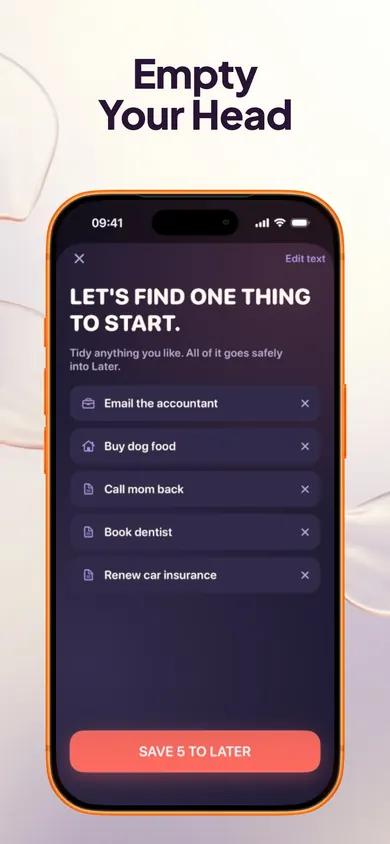
Get everything out of your head first, then pick just one thing. Now's Brain Dump splits a messy paragraph into tasks; the daily plan holds up to three, and only one is on screen at a time.
Does a two-minute start actually help?
It helps with the start, which is the part you are stuck on. Two minutes is small enough to feel possible. After that, continuing is a separate, optional choice. In Now, stopping at two minutes still counts.
Is Now free?
The one-task screen, two-minute starter, Stuck button, task breakdown, Brain Dump, focus timers, daily plan, reminders and Quiet Mode are free forever. Now Pro ($4.99 a month, $29.99 a year or $59.99 lifetime, US prices) adds routines, full Time Mirror history and CSV export.
Is Now an ADHD treatment?
No. Now is a productivity-support tool and does not diagnose, treat or manage ADHD or any medical condition.
Open Now in the App Store
Pick the thing you want to do. Find the two-minute version. Open Now in the App Store; the starter and the Stuck button are free.

Updated November 2026
Related
- Now: one task, one small step, two minutesNow shows one task, one concrete first step and a two-minute timer. Tap I'm stuck to go smaller. Free on iPhone, no account.
- 2-minute rule vs Pomodoro for ADHDPomodoro asks for 25 minutes up front; the 2-minute rule asks for two. Slide to compare them on a real task, and see when each one wins.
- ADHD time estimate calculator (your own multiplier)Enter three past tasks, guessed vs real minutes, and get your personal time multiplier, then a realistic start time. Free, runs in your browser.
- College students with ADHD: the statistics, sourcedHow many college students have ADHD, how they rate their strengths, and how grades and enrollment compare. Every number linked to its source.