 Free on iPhone · no account
What is an ADHD time estimate calculator?
It turns your gut guess for a task into a realistic number by multiplying it by how much your past guesses were off. Most online versions use one fixed multiplier for everyone. This one uses yours: three tasks you remember, guessed versus real minutes, divided out.
The gap is not unique to ADHD. In Buehler, Griffin and Ross (Journal of Personality and Social Psychology, 1994), 37 students estimated their senior theses would take 33.9 days on average; the real average was 55.5 days. That is a 1.64x multiplier, and even their worst-case guesses (48.6 days) came in short.
Your guess is not wrong. It is just missing a number you can measure.
Who it's not for
- Anyone looking for an ADHD test. This is arithmetic, not assessment.
- Project managers estimating team work; one person's three tasks is too small a sample for that.
- People who never guess at all. If you do not estimate, start by guessing, then come back.
Honest limits
Three tasks is a tiny sample, so treat the multiplier as a starting point. Short tasks swing it a lot: guessing 2 minutes for something that takes 10 is a 5x miss. Use tasks of the kind you are about to do. Your multiplier also changes with sleep, energy and interruptions, which no calculator knows.
How it works in 3 steps
- Remember three tasks. Guess first from memory, then fill in what they really took.
- Read your multiplier. Real total divided by guessed total, so one weird task cannot dominate.
- Plan backwards. Type your next guess and a deadline; the tool gives the realistic length and a latest start time.
A mini story
Friday, 5:10 PM. Dinner at a friend's at 7. "Shower and get ready: 20 minutes, I can leave at 6:40." Multiplier from last week's three tasks: 2.3x. Realistic: 46 minutes, so start by 6:14, not 6:20, and the drive needs its own guess too. Arrives 7:04 instead of 7:25. Not perfect. Better.
A scenario we wrote, not a user story.
Proof: how Now keeps the multiplier for you
Typing past tasks into a web page works once. In Now, every task you start gets a recorded time, and Time Mirror compares your estimates with the time you actually recorded. The free app includes the one-task screen, the two-minute starter, focus timers of 5, 10, 15 or 25 minutes, and the Stuck button. Full Time Mirror history and insights are Now Pro ($4.99 a month, $29.99 a year or $59.99 lifetime, US prices).
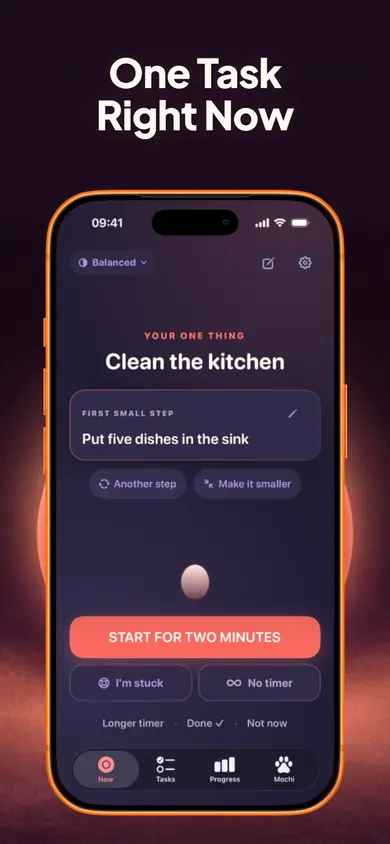
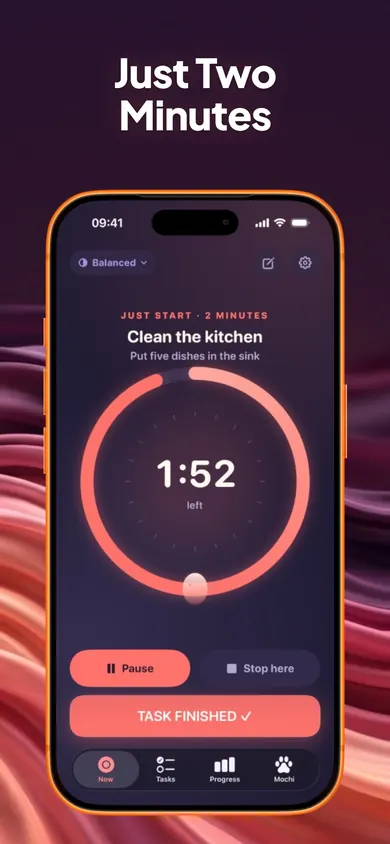
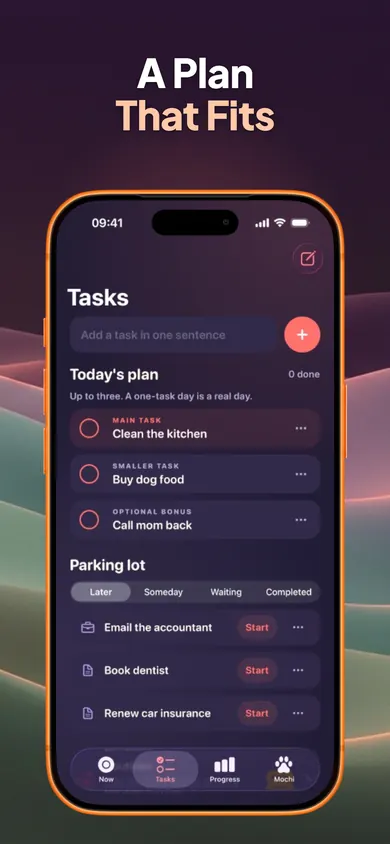
One design decision: Time Mirror shows the gap as a fact, with no score and no red numbers. A late estimate is information, not a failure. Pick something else if you need a shared team calendar or a visual day planner; Now holds one task at a time on purpose.
Your result, explained
With the example numbers, your guesses added up to 30 minutes and the tasks took 80, a multiplier of 2.67x. A 20-minute guess becomes about 53 minutes. Change any number above and this updates.
| Multiplier | 20-min guess becomes |
|---|---|
| 1.0x | 20 min |
| 1.64x (1994 thesis study) | 33 min |
| 2.0x | 40 min |
| 3.0x | 60 min |
Time estimate questions
How do I calculate how long a task will really take?
Use your own history. Write down your guess for a few tasks, time them, and divide the real total by the guessed total. That ratio is your personal multiplier; multiply your next guess by it.
What multiplier should I use for ADHD time blindness?
We do not give a fixed one, because there is no single number that fits everyone. The calculator works out yours from three of your own tasks, which is more honest than a generic 1.5x or 2x.
Why do I always underestimate how long things take?
Almost everyone does. Psychologists call it the planning fallacy. In a 1994 study, 37 students guessed their theses would take 33.9 days on average; they took 55.5. Many people with ADHD describe the gap as bigger, but the calculator only uses your own numbers.
Does the calculator save my data?
No. It runs in your browser and nothing you type is sent anywhere or stored.
How does Now help with time estimates?
Now's Time Mirror compares your estimates with the time you actually recorded, so the multiplier builds itself as you use the app. Full Time Mirror history and insights are part of Now Pro; the one-task screen, two-minute starter and focus timers are free.
Is this a diagnosis tool for ADHD?
No. It is arithmetic on your own guesses. Now is a productivity-support tool and does not diagnose, treat or manage ADHD. For assessment, talk to your clinician.
Make it a habit with Now
Stop typing old tasks into calculators: let each start record itself. Get Now on the App Store; the starter and timers are free.
Updated November 2026
Related
- Now: one task, one small step, two minutesNow shows one task, one concrete first step and a two-minute timer. Tap I'm stuck to go smaller. Free on iPhone, no account.
- Why can't I start tasks I want to do?Wanting to do it and starting it are different skills. Tap what's in your way for one next move, then read 12 straight answers. No account needed.
- College students with ADHD: the statistics, sourcedHow many college students have ADHD, how they rate their strengths, and how grades and enrollment compare. Every number linked to its source.
- How to start studying with ADHD: a two-minute checklistStuck staring at the syllabus? A short checklist for starting to study with ADHD: shrink the first step, set two minutes, pick what's in the way.