Attention span test · at home · free printable

Focus, checked at home
in 20 seconds.

For curious adults: tap every H in 20 seconds, then print three fair weekly retests.

Tap every H. Skip the rest.

The clock starts on your first tap. Keyboard: Tab to a letter, Enter to mark it.

Download Attention Age: Focus Test on the App StoreFree on iPhone · Attention Age

How do you test your attention span at home?

Pick one simple task, time it, score hits and mistakes, then repeat it under the same conditions once a week and compare only with yourself. A paper letter hunt does this with a pen and a phone timer. You get a number you can track, not a label.

A home attention test is a ruler for you, not a verdict about you.

A Tuesday at the kitchen table

Here is how the kit is meant to run. You print the PDF on Sunday, put Form A on the table and set the phone to 60 seconds. You slash 31 H's, slash 2 wrong letters by mistake and stop in row 13. Score: 29.

The next Tuesday, same time, after a worse night, Form B scores 27. Down 2 points. That is inside the "about the same" band, and the log shows the bad night. Week three, Form C: 33. One good week is not a trend, so you keep going.

The log is the test. One sheet is just a moment.
Free printable: three sheets and a log

Five letter-size pages, no email, no sign-up:

  1. One page of rules, scoring and fairness notes.
  2. Forms A, B and C: 16 rows of 24 letters, each with exactly 48 H's.
  3. A weekly log with date, time, sleep, hits, slips and misses, plus the answer key.
Download the PDF (5 pages)

Forms rotate so you cannot memorise where the H's are. The decoys (N, K, M, A, F, E, X, W, V) share straight strokes with H on purpose.

Honest limits of a home test

  • It measures one task, on paper, for 60 seconds. Not "attention" in general.
  • Scores rise with practice. That is skill at the sheet, not proof of wider change.
  • Sleep, caffeine, noise and mood move the number. Log them.
  • It is not a screening tool for ADHD, concussion or memory problems.

This is general information, not medical advice. Talk to your clinician.

What the five-minute app version adds

We make Attention Age. The paper kit is a fair first step; the app is the longer ruler. It runs three timed tasks in about five minutes: Signal Watch (tap the signals, skip the decoys), Interference (judge the middle arrow) and Tracking (follow moving shapes).

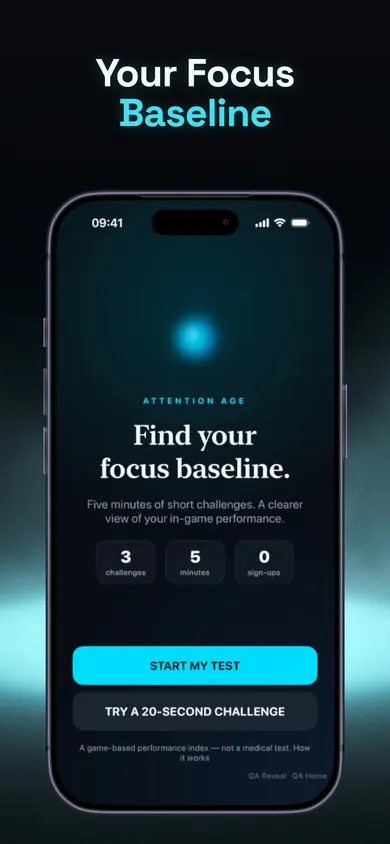
Attention Age start screen: find your focus baseline, 3 challenges, 5 minutes, 0 sign-ups
Three challenges, five minutes, no sign-up.
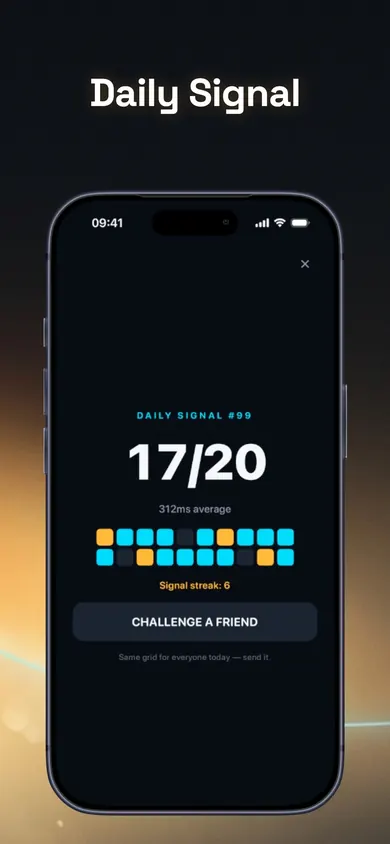
Daily Signal 20-second challenge showing 17 out of 20 and a result grid
The free Daily Signal: one 20-second challenge a day.
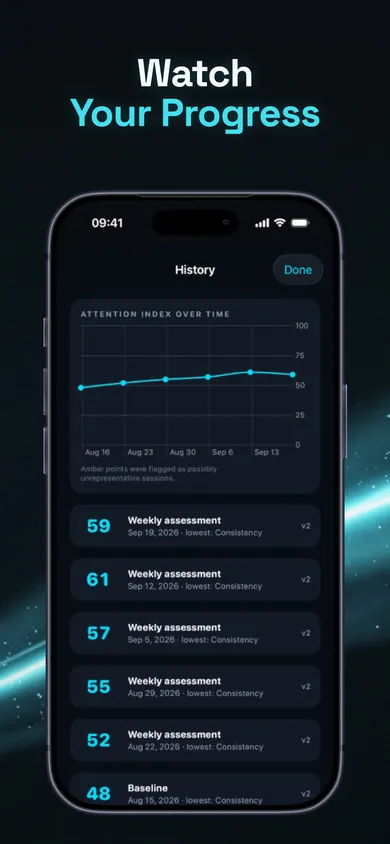
History list of weekly assessments with Attention Index scores over time
Weekly re-tests stay in your history, lower ones too.

Same tasks, same scoring, any day you choose: that is what makes a retest fair.

Home attention tests compared

OptionTimeWhat you getFair retest?
Online "how focused are you" quiz2 minYour opinion of yourselfNo: answers drift with mood
The 20-second hunt above20 sHits, slips, reaction paceLoose: new grid each time
Printable sheets A, B, C60 sHits minus slips, weekly logYes: three equal forms
Attention Age full test~5 min0 to 100 index, five categories, validity checkYes: weekly re-test, free

Who should pick something else: if you want a diagnosis, a doctor or psychologist is the right route; if you want a pure puzzle habit, a brain-game app fits better than a test.

Reading your 20-second result

The hunt above shows three numbers. Hits are H's you found. Slips are other letters you tapped, the paper version of hitting a decoy. Pace is the average gap between your hits. Fast with slips usually means rushing; slow with no slips usually means careful. Neither is "good" by itself.

One design decision we made in Attention Age follows the same idea: changes under 5 points are labelled "about the same", and early gains from familiarity are flagged rather than celebrated. The app also keeps a validity check that flags a session that probably wasn't a real attempt.

Speed without slips is the number worth watching.

Questions about testing attention at home

Can you really test attention span at home?

You can test how well you hold attention on one task for a fixed time, at home, for free. A letter-cancellation sheet or a timed tap task gives you a number you can repeat. What you cannot do at home is diagnose anything; that needs a clinician.

What is a normal attention span for an adult?

There is no single agreed number for adults. Attention depends on the task, sleep, interest and noise, which is why we suggest comparing you with you, week to week, under the same conditions.

Is this a test for ADHD?

No. The sheet and the 20-second hunt measure performance on one simple task on one day. ADHD is diagnosed by a clinician from history and symptoms across settings. This is general information, not medical advice. Talk to your clinician.

Why do my scores go up in week two?

Mostly familiarity. You learn the shape of the H and the rhythm of the rows. That is why the PDF has three forms and why we treat changes under 5 points as about the same.

How often should I retest?

Once a week is enough, at the same time of day. Daily tests mostly measure how well you have learned the test.

How does Attention Age compare with the paper sheet?

The paper sheet is one task. Attention Age runs three timed tasks in about five minutes and turns them into a 0 to 100 Attention Index with five category scores, a validity check and a weekly re-test, all on your iPhone.

Open Attention Age in the App Store

Run the paper sheet this week. When you want the five-minute version with weekly re-tests, open Attention Age in the App Store. The test, the Daily Signal and weekly results are free; Pro adds more drills and longer focus sessions.

Download Attention Age: Focus Test on the App Store

Open Attention Age in the App Store · Updated November 2026

Related