 Measuring focus progress
How do you measure attention span improvement?
Take the same short attention test, under the same conditions, once a week; count your first two results as one baseline, and only believe changes of 5 points or more that hold for two weeks. Everything else on this page is detail on the six ways people get that wrong, and how to fix each one.
We make Attention Age, a five-minute test on iPhone built from three timed tasks, with a weekly re-test that uses the same tasks and scoring. The rules below work with any test you repeat, though. Updated November 2026.
The six mistakes, fixed one by one
Switching tests between tries
A quiz one week, a reaction game the next, a reading timer after that. Each measures something different, so the change between them means nothing. Fix: pick one test and keep it. Attention Age's weekly re-test uses the same three tasks (Signal Watch, Interference, Tracking) and the same scoring as your first session, which is the whole point.
Retesting in a different state
Monday at 7 a.m. after coffee versus Friday at 11 p.m. on the sofa is not a fair comparison. Fix: same rough time of day, same room, same phone, same hand, same glasses. Write down anything unusual, like a short night.
Celebrating the second-test jump
Short tasks get easier once the rules are familiar. In Bartels and colleagues in BMC Neuroscience (2010), the biggest gain across months of repeated testing came between the first and second session, and the authors suggest using that second test as a "dual baseline". Fix: average tests 1 and 2 and measure from there. Attention Age flags early gains that likely come from familiarity, so you are reminded at the moment it matters.
Reading a 2-point change as progress
Scores wobble from day to day. Fix: set a threshold before you look. We use 5 points: in the app, changes under 5 are labeled "about the same", and we would rather say that plainly than hand you a small fake win.
Deleting the bad days
If you only keep the good results, your chart will always go up. Fix: keep everything and read the run. Attention Age keeps every weekly result in your history, lower ones included, and plots the index over time.
Mistaking a test score for real life
Getting better at three tasks is improvement at those tasks; it is not proof that your work, reading or conversations changed. Fix: log one real-life number next to the score, such as focused minutes finished per day or pages read before you reached for the phone.
A fair retest is boring on purpose: same test, same conditions, a threshold you chose in advance.
Questions about tracking focus progress
How do I know if my attention span is improving?
Take the same short attention test under the same conditions once a week, treat your first two results as your starting point, and only count changes of 5 points or more that hold for two weeks in a row. Pair that with one real-life measure, such as minutes of focused work you actually finished.
How often should I test my attention span?
Once a week is enough. Testing every day mostly teaches you the test. In Attention Age the weekly re-test can be taken on any day that suits you, and it is always free.
Why did my score jump so much on the second try?
Mostly because the rules are no longer new. In Bartels and colleagues in BMC Neuroscience (2010), the largest gain in repeated testing came between the first and second session, with little change at later intervals. Treat the second test as part of your baseline.
Can my attention score go down even if I am trying?
Yes. A bad night, a noisy room or a different hand position can cost several points. Attention Age keeps every result, including lower ones, so a single dip sits in context instead of being hidden.
Is an attention test score the same as an attention span in minutes?
No. A test like Attention Age reports how you did on specific timed tasks on that phone. It is not a number of minutes and not compared with other people. Minutes of uninterrupted work are a separate, useful measure to log alongside it.
Can an app tell me if I have ADHD?
No. Attention Age is an entertainment and self-practice app, not a medical, clinical or diagnostic test. If focus problems affect work, school or relationships, talk to a clinician.
Honest limits of measuring attention at home
- A phone test measures performance on its own tasks on that device. Attention Age is not compared with any population and gives no age, percentile or ranking.
- Scores usually rise with practice. That shows improvement at the tasks, not proof of broader change.
- It cannot see why a score moved: sleep, stress, medication changes and a cracked screen all look the same in a number.
- The test, weekly results and the three core practice tasks are free. Seven extra drills and 45 and 90-minute focus sessions need the optional Pro subscription, monthly or annual.
Who this method is not for
If you want to know whether you have ADHD or another condition, a home test is the wrong tool; that needs a clinician. If your focus changed suddenly, or came with headaches, memory gaps or mood changes, skip the app and book an appointment. And if you want to compare yourself with other people your age, we deliberately don't do that, so pick a different test.
This is general information, not medical advice. Talk to your clinician.
What your counter result means in the app
The counter at the top follows the same reading rules we built into the weekly re-test. Here is where you would see each one on your phone.
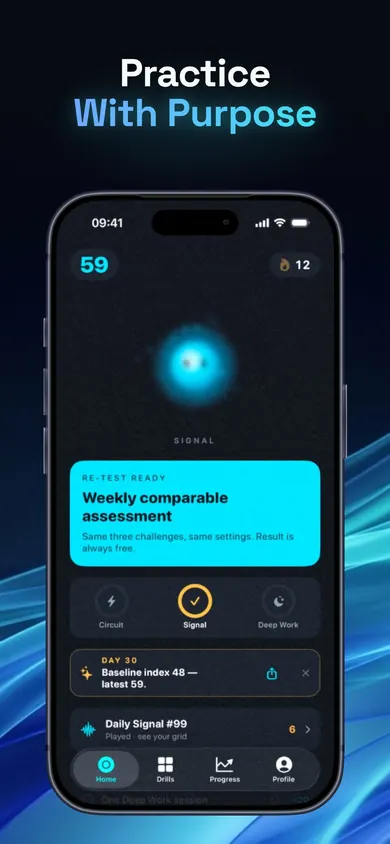
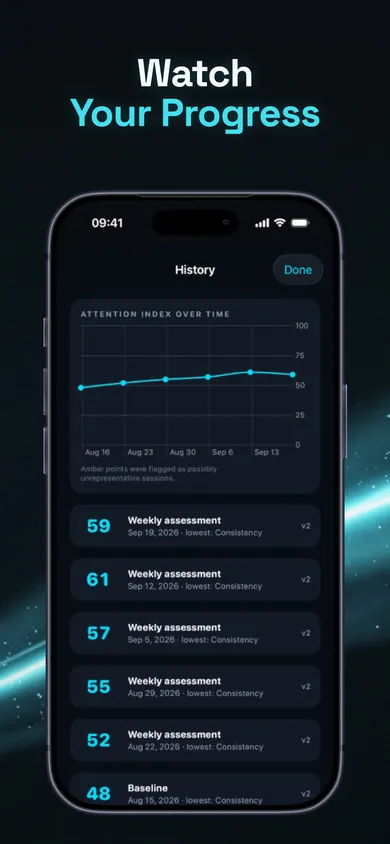
| Change | Test number | How to read it |
|---|---|---|
| Under 5 points either way | Any | About the same. Keep going. |
| 5 or more up | 2nd | Mostly familiarity. Fold it into your baseline. |
| 5 or more up | 3rd or 4th | Promising. Wait for next week to confirm. |
| 5 or more up, twice | 5th or later | A real gain at these tasks. |
| 5 or more down | Any | Check sleep, time and setting before worrying. |
A mini story: the phone-free month
A reader decided to keep their phone out of the bedroom for a month and wanted proof it helped. Week one: 54. Week two: 61, and the app flagged that early gains are often familiarity. Instead of celebrating, they averaged the two into a baseline of about 57. Week three: 59, "about the same". Week four: 63. Week five: 64. Two weeks in a row at 5 or more above baseline, tested on Sunday mornings in the same chair.
Their real-life number told the more useful story: focused work sessions finished went from two a day to four. The score said they got better at the tasks. The log said their days changed. They needed both to believe it.
How it works in 3 steps
- Take the five-minute baseline. Three timed tasks give a 0 to 100 Attention Index and five category scores, with a validity check that flags sessions that probably weren't a real attempt.
- Re-test once a week. Same tasks, same scoring, any day that suits you. Weekly results are free.
- Read the change honestly. Under 5 points is "about the same", early familiarity gains are flagged, and every result stays in your history.
One design decision: we don't send a reminder that says your score "dropped". A weekly result is a data point, and nagging about it would push people to only test on good days.
Get Attention Age free
Take your baseline this week and re-test next week in the same chair. Get Attention Age free on the App Store.

Related
- Attention Age: a five-minute attention span testA five-minute attention span test for iPhone: three timed tasks, a 0-100 Attention Index explained in plain language, then daily practice.
- Is my attention span getting shorter? Six myths checkedThe 8-second goldfish claim, the 10-minute lecture limit and four more attention myths, checked against the studies they came from.
- New Year focus reset checklist (5 weeks, sortable)A five-week New Year focus reset checklist you sort by your worst distraction. Baseline test, phone rules, sleep and a fair re-test on January 4.
- The flanker test explained, step by step (with a 12-trial demo)What the flanker (arrow) test measures, what each screen asks, and what your interference cost means. Try a 12-trial demo in your browser.