Is your attention span getting shorter, or is that a myth?
Probably not in the way the headlines say: there is no good evidence for one fixed, shrinking "attention span" number, so the honest move is to measure your own focus under the same conditions over time. What does change, a lot, is how often your day interrupts you.
If you just passed the 8-second mark on the counter above, you have already outlasted the famous goldfish claim. Below are six attention span myths, what the source actually measured, and what you can do instead of worrying.
You are not a goldfish. You are a person with a phone that buzzes.
Six attention span myths vs facts
-
Myth Humans now have an 8-second attention span, shorter than a goldfish.
Fact A 2016 review by Bradbury in Advances in Physiology Education traces the number to a study commissioned by Microsoft, explains that it reflected the average time a person spends on a web page before looking elsewhere, and notes that nobody knows how to measure a goldfish's attention span. Goldfish memory, which has been measured, is actually quite good.
-
Myth Everyone switches off after 10 to 15 minutes of a lecture or meeting.
Fact The same 2016 review found the primary data do not support a fixed 10 to 15 minute limit. Attention varied more with who was teaching than with how long they talked.
-
Myth Doing five things at once trains you to be good at doing five things at once.
Fact In Ophir, Nass and Wagner's 2009 PNAS study, heavy media multitaskers were more distracted by irrelevant information and slower on a task-switching test than light multitaskers. It was a comparison of groups, so it cannot prove cause, but it does not support "practice makes perfect" either.
-
Myth A few weeks of brain games will make you sharper at everything.
Fact The 2016 review by Simons and colleagues found training improves the trained tasks, with less evidence for closely related tasks and little for everyday life. That is why Attention Age's listing says a rising score shows improvement at the tasks, not proof of broader change.
-
Myth If you can't focus, an online attention test can tell you whether you have ADHD.
Fact The NIMH ADHD overview (reviewed 2026) notes symptoms begin in childhood and usually continue into adulthood; assessment is a clinician's job. Attention Age says plainly it is not a medical, clinical or diagnostic test. This is general information, not medical advice. Talk to your clinician.
-
Myth One bad score on one bad day means your focus is getting worse.
Fact Single sessions are noisy. Sleep, time of day and a phone call halfway through all move the number. A fair check repeats the same tasks, the same way, and looks at the trend.
Who this page (and our app) is not for
If you want a diagnosis, a percentile or a number that tells you how you compare with other people, Attention Age will disappoint you, on purpose. Its 0-100 Attention Index is not an age, a percentile or a ranking and is not compared with any population. If focus problems are hurting your work, school or relationships, a clinician is the right first stop. And if you mainly want to block apps, a dedicated app blocker will do more for you than any test.
Attention span questions people ask
Is the 8-second attention span real?
No good evidence supports it. A 2016 review in Advances in Physiology Education traces the figure to a Microsoft-commissioned report, notes that it reflected time spent on a web page, and points out that nobody knows how to measure a goldfish's attention span.
Why does it feel harder to focus than it used to?
Feelings are real data about your days, even if the headline numbers are not. More notifications, more tabs and less sleep all make focus feel harder. The useful question is whether your own focus changes when those conditions change, and that is something you can measure.
Does social media shorten your attention span?
The research is mixed and mostly correlational. A 2009 study in PNAS found heavy media multitaskers did worse on a task-switching test and were more distracted by irrelevant information, but it could not show that media use caused the difference.
Can I train my attention span?
You can get better at specific attention tasks with practice. A 2016 review in Psychological Science in the Public Interest found training reliably improves the trained tasks, with much less evidence for everyday benefits. We built Attention Age with that in mind.
Is trouble focusing a sign of ADHD?
It can have many causes. The NIMH (reviewed 2026) notes ADHD symptoms begin in childhood and usually continue into adulthood. Only a clinician can assess it. This is general information, not medical advice. Talk to your clinician.
How can I check my own focus without guessing?
Use the same short test under the same conditions once a week and look at the trend, not one day. Attention Age's weekly re-test uses the same tasks and scoring and labels changes under 5 points "about the same".
A mini story: checking instead of worrying
Imagine you read the goldfish line on a Sunday night and feel a small chill. Instead of scrolling for more headlines, you take Attention Age's five-minute test on Monday morning: Signal Watch, then Interference, then Tracking. You get an Attention Index and five category scores, each explained in plain words, plus one suggested practice focus.
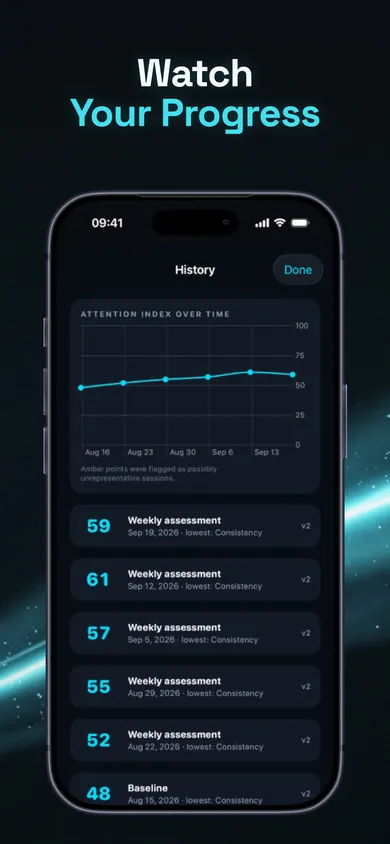
The next Monday you re-test at the same time. The app keeps both results, including the lower one, and calls a 3-point move "about the same". The panic turns into a line on a chart you can actually read. That's the whole point: replace a scary statistic with your own data, collected fairly.
A trend you measured beats a statistic you scrolled past.
One design decision we made: Lumen, the little light companion, grows from showing up (assessments, focus minutes, milestones), never from your score. We did not want a bad Monday to feel like a punishment.
Comparison strip: the headline vs what was measured
| Headline | What was actually measured | Better question |
|---|---|---|
| "8 seconds, less than a goldfish" | Time on a web page before looking away | How often am I interrupted? |
| "10-minute attention limit" | A 1978 note-taking review, not attention | Does focus change with the task? |
| "Multitaskers are better at it" | Heavy multitaskers did worse on switching | Can I single-task for 25 minutes? |
| "Brain games make you smarter" | Gains mostly on the trained tasks | Did my own test change, fairly? |
Sources: Bradbury, Advances in Physiology Education, 2016; Ophir, Nass and Wagner, PNAS, 2009; Simons et al., Psychological Science in the Public Interest, 2016. Updated November 2026.
What is free and what is Pro
The five-minute test, weekly re-tests, the 20-second Daily Signal, practice for the three core tasks and 10 or 25 minute Deep Work sessions are free. Attention Age Pro (monthly or annual) adds seven more precision drills and 45 and 90 minute Deep Work sessions. Your earned results are never locked. One limitation: it is iPhone only, and results stay on that phone unless you export the CSV.
Measure it, don't guess it
Five minutes this week, five minutes next week, the same way. Make it a habit with Attention Age.

Related
- Attention Age: a five-minute attention span testA five-minute attention span test for iPhone: three timed tasks, a 0-100 Attention Index explained in plain language, then daily practice.
- Free ADHD attention tests online: 6 myths vs factsCan a free online attention test tell you if you have ADHD? Six myths vs facts with CDC, NIMH and Mayo Clinic sources, plus what a 5-minute test can show.
- How to measure attention span improvement (6 mistakes to fix)Trying to improve your focus? Six common mistakes that fake or hide progress, how to fix each one, and a counter that reads your score change.
- New Year focus reset checklist (5 weeks, sortable)A five-week New Year focus reset checklist you sort by your worst distraction. Baseline test, phone rules, sleep and a fair re-test on January 4.