
How do you stay focused at work during the holidays?
Protect one block of single-task work a day, keep the phone out of reach during it, batch messages, and move hard thinking away from short-sleep mornings. December adds interruptions, social plans and shorter nights at the same time, so the fix is fewer switches, not more willpower.
December does not need more effort. It needs fewer switches.
Eight findings on holiday distraction, checked November 2026
We read each source ourselves. Where a finding has been challenged since, we say so.
Switching tasks has a real cost
Task-switching experiments by Rubinstein, Meyer and Evans found that every switch costs time, and the cost grows with task complexity. The American Psychological Association's summary (2006) notes these blocks can cost as much as 40 percent of productive time. Takeaway: one switch is cheap; forty a day is not.
Interrupted work gets faster and more stressful
In Mark, Gudith and Klocke (2008), people who were interrupted finished tasks in less time but reported more stress, frustration, time pressure and effort. Takeaway: "I got it done anyway" can hide the price.
Unfinished tasks leave attention residue
Leroy (2009) showed that switching away from an unfinished task left "attention residue" that hurt performance on the next one. Takeaway: a one-line "where I stopped" note helps you put the first task down.
Minds wander almost half the time
Sampling thousands of adults through their iPhones, Killingsworth and Gilbert (2010) found minds wandering in 46.9 percent of samples. Takeaway: drifting is normal; noticing and coming back is the skill.
Heavy media multitaskers filtered worse, with caveats
Ophir, Nass and Wagner (2009) found heavy media multitaskers did worse at ignoring irrelevant information in lab tasks. A 2018 review by Uncapher and Wagner called the wider evidence mixed. Takeaway: treat it as a hint, not a law.
The phone-on-the-desk effect is contested
Ward and colleagues (2017) reported lower working-memory scores with the phone on the desk than in another room. A 2022 replication by Ruiz Pardo and Minda did not find the effect. Takeaway: moving the phone is free, so test it on yourself.
Short sleep slows you and adds mistakes
The National Heart, Lung, and Blood Institute (updated 2022) says sleep deficiency can cause problems with focusing and reacting, and you may take longer to finish tasks and make more mistakes. Takeaway: after a late party, schedule easy work first.
Micro-breaks lift energy more than output
A meta-analysis by Albulescu and colleagues (2022) found breaks of ten minutes or less raised vigor and reduced fatigue, with a smaller effect on performance. Takeaway: take the break, but don't expect it to finish the report.
A focused holiday workday in three steps
- Pick the one task. Before you open email, write down the single piece of work that would make today count. Not three. One.
- Run one block. Phone in a drawer or another room, one window open, a 25-minute timer running. Stop when it ends, even mid-sentence, and write where you stopped.
- Batch the rest. Answer messages in two windows, say 11:30 and 4:00. Holiday logistics, gift orders and party threads go in the same windows.
One task, one block, two message windows: that's the whole December plan.
Tab-hopping day vs single-task day
| Tab-hopping day | Single-task day | |
|---|---|---|
| Phone | Face-up next to the keyboard | In a drawer for one block |
| Messages | Answered as they land | Two set windows |
| Hard task | Squeezed between calls | First 25-minute block |
| Switching away | Mid-thought, no note | One-line "where I stopped" |
| After a late night | Hardest work at 9 am | Easy tasks first, hard task later |
Mini story: the week of December 14
Picture an accountant with the year-end close on Friday, a team lunch on Tuesday and a family party on Wednesday night. Monday is a tab-hopping day: 30 open tabs, a phone that lights up with the family group chat every few minutes, and the reconciliation still half-done at six.
Tuesday she tries one block. Phone in her bag in the coat cupboard, the reconciliation file and nothing else, a 25-minute timer. She gets through two accounts and writes "stopped at line 48, check FX rate" before lunch. Thursday, after the party, she does filing in the morning and the hard review after 2 pm. Nothing heroic. Just fewer switches.
Honest limits of this list
- Most of these studies ran in labs or with office workers in one country; your job may differ.
- Two findings (media multitasking and the phone-on-the-desk effect) have mixed or failed replications. We kept them because the experiment costs nothing, not because they are settled.
- A checklist does not fix a workload that is simply too big. That is a conversation with your manager.
- If focus trouble lasts beyond the season or affects daily life, talk to a clinician. This is general information, not medical advice. Talk to your clinician.
What your ring score means
The ring at the top is a commitment count, not a test. Zero to two moves: start with the phone-away block, it is the easiest to notice. Three to four: you have a plan; check it on Friday. Five or six: pick the two you will actually keep through December 24 and drop the rest. People who promise six changes in Christmas week usually keep none.
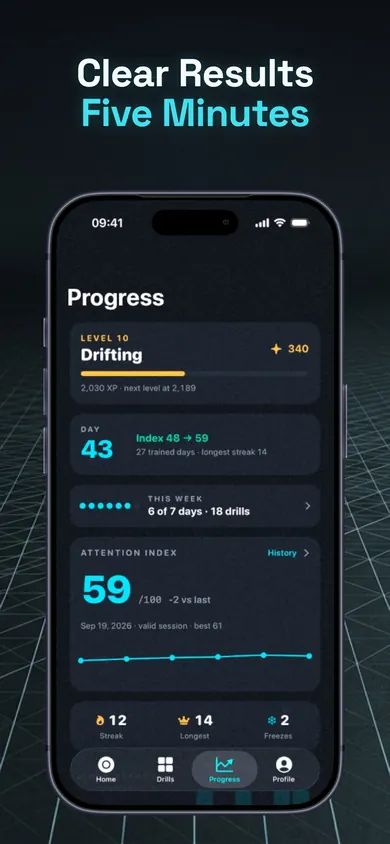
If you want a number to compare against, Attention Age has a five-minute test built from three timed tasks and a 0 to 100 Attention Index. Take it on a normal week in early December, then a weekly re-test with the same tasks and scoring. Changes under 5 points are labelled "about the same".
The focus timer we built for this
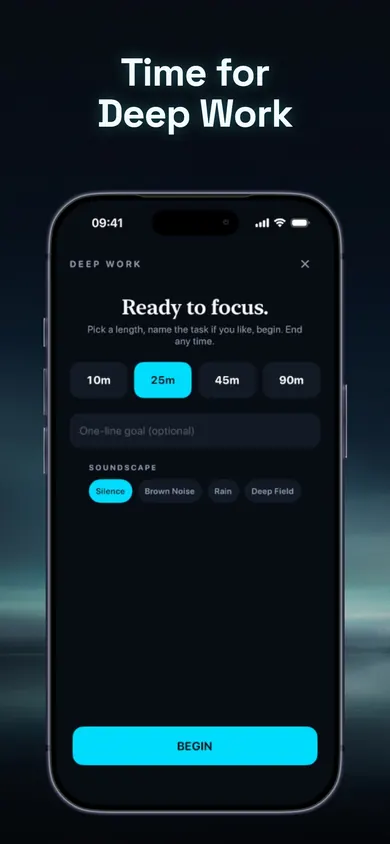
We make Attention Age. Its Ready to Focus screen does one thing: name one task, pick a length, begin. 10 and 25 minute sessions are free; 45 and 90 minutes need Pro. A Lock Screen Live Activity shows the countdown, with optional brown noise, rain or Deep Field ambience. One design decision we made: the companion, Lumen, grows from finished sessions and showing up, never from your score.
Who should pick something else: if you need to block apps across the day, a dedicated app blocker or Screen Time limits will do more than a timer. If you want brain-game variety rather than focus sessions, a puzzle app is a better fit.