Is meditation or brain training better for focus?
Neither has strong evidence of large, broad gains: mindfulness training shows small improvements on attention tests, and brain training mostly improves the trained tasks themselves. So the honest answer for you is an experiment, not a verdict. Try each for a week, measure both weeks the same way, and keep the one you will actually do.
We make Attention Age, a five-minute attention test with a weekly re-test, so we have a stake in "measure it". We also have a stake in not overselling it, which is why this page spends as much time on the traps as on the plan.
The best focus method is the one that survives week three. Measure two weeks first.
What you measure with, inside the app
Three timed tasks make up the test: Signal Watch (tap the signals, skip the decoys), Interference (judge the middle arrow) and Tracking (follow moving shapes). They feed a 0–100 Attention Index with five category scores.
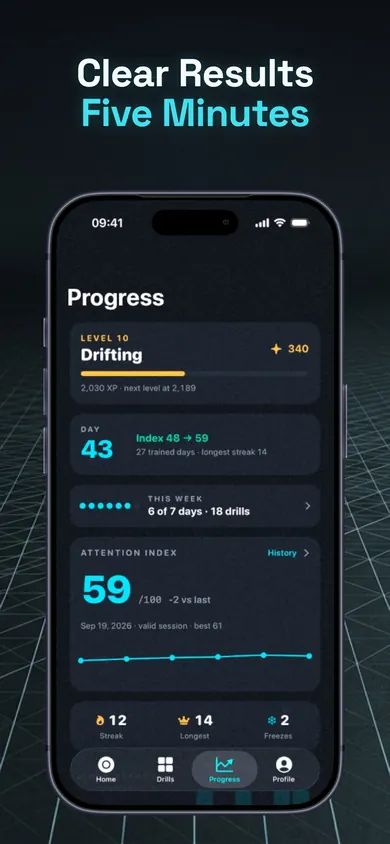
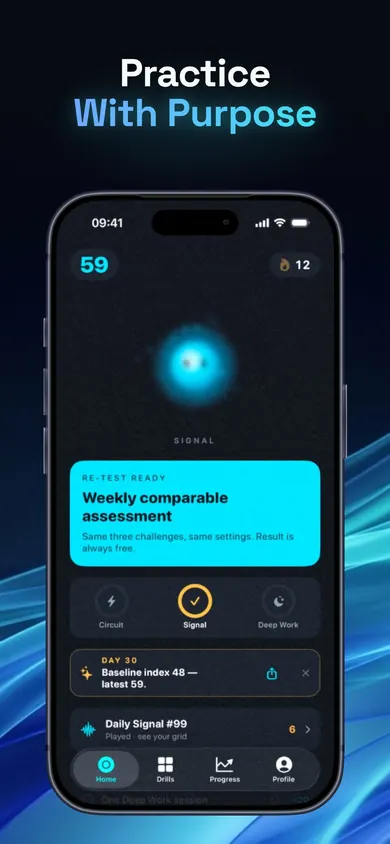
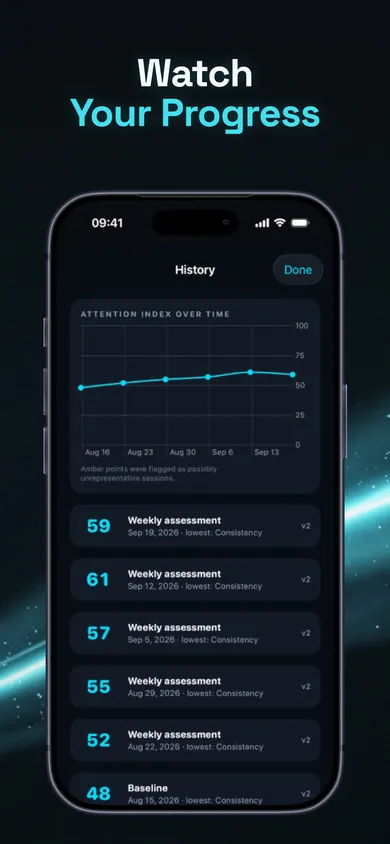
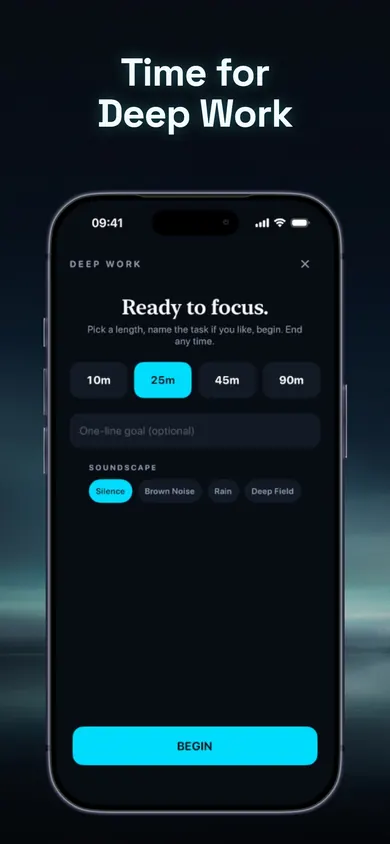
Meditation vs brain training: the comparison strip
| Meditation week | Drill week | |
|---|---|---|
| What you practise | Resting attention on one thing, noticing drift, coming back | Fast, timed tasks: tap or hold, judge arrows, track shapes |
| Daily time in our plan | 10 minutes, same time each day | A Quick circuit (about 2 minutes) or Standard (about 5) |
| Best evidence we found | Small gains on attention (g = 0.18) and executive control (g = 0.18) across 27 RCTs (Yakobi et al., 2021); g = 0.34 for executive control in 13 studies (Cásedas et al., 2020) | Gains on the trained tasks; less on related tasks; very little on everyday performance (Simons et al., 2016) |
| Bias in a re-test | Low: you never practise the test tasks | High: the drills resemble the test, so scores may rise from familiarity |
| Cost | Free with any timer or recording | Signal Watch, Interference and Tracking practice is free; seven extra drills need Pro |
| Feels like | Slow, quiet, sometimes boring | Quick, gamey, easy to start |
Drills will look better on a drill-like test. That is the trap, so plan for it.
How to run the two-week comparison fairly
- Fix the conditions. Same time of day, same room, same phone settings for all three tests. Attention Age has a validity check that flags sessions that probably don't reflect a real attempt; if one gets flagged, redo it the next day.
- Keep one non-app measure. The re-test favours drill weeks, so add something the drills never touch: the number of 25-minute Deep Work sessions you finished, or a one-line evening note rating how often you drifted at work (1 to 5).
- Read the result like a skeptic. A difference under 5 points is "about the same" in the app. A drill-week jump that your Deep Work count doesn't echo is mostly practice at the test.
One design decision we made for this: the weekly re-test is free and can be taken on any day that suits you, so you can line it up with the end of each method week without paying for anything.
Questions people ask before comparing
Is meditation better than brain games for concentration?
On current evidence neither wins by much. A 2021 meta-analysis of 27 randomized trials in healthy adults found mindfulness gave small gains on attention tests (Yakobi et al., 2021), and a major 2016 review found brain training mostly improves the trained tasks themselves (Simons et al., 2016). Your own fair comparison is the most useful answer you can get.
How long does meditation take to improve focus?
Trials usually run for weeks, not days. In the 2021 meta-analysis, the number of in-class sessions mattered more than total hours: more sessions went with larger effects (Yakobi et al., 2021). Two weeks is enough for a first look, not a verdict.
Do brain training apps improve attention in daily life?
Evidence for everyday transfer is thin. The National Institute on Aging says there is not enough evidence that commercial brain-training apps have the effects seen in the ACTIVE study (NIA, reviewed 2024). Attention Age says the same about itself: higher scores show improvement at its tasks, not proof of broader change.
Will my score go up just because I practised the test?
Probably, a little. Retaking cognitive tests raises scores by about a quarter of a standard deviation on average (Hausknecht et al., 2007). That is why Attention Age flags early gains from familiarity and calls changes under 5 points "about the same".
Can I do both meditation and brain training?
Yes, and many people will. For the comparison, though, run them in separate weeks so you can tell which week moved what. Afterwards, keep whichever you actually did without dreading it.
Is Attention Age a meditation app?
No. It has a five-minute attention test, practice drills, a weekly re-test and a Deep Work timer with optional brown noise, rain or Deep Field ambience. For guided meditation, use a meditation app, a class or a recording you like, and use Attention Age only to measure.
Is this a test for ADHD?
No. Attention Age is an entertainment and self-practice app, not a medical, clinical or diagnostic test. This is general information, not medical advice. Talk to your clinician.
Honest limits
- Two weeks with one person is a hint, not a study. Sleep, deadlines and caffeine can swamp either method.
- Order matters. Week two benefits from week one's practice at the test, so if you can, repeat the pair later in the opposite order.
- The Attention Index reflects performance on these specific tasks on this device. It is not an age, a percentile or a ranking, and it is not compared with any population.
- Attention Age has no guided meditation. Bring your own.
- Pro (monthly or annual subscription) adds seven precision drills and 45 and 90-minute Deep Work sessions. The test, weekly re-tests and the three core tasks are free.
Who this is not for
If you are trying to find out whether you have ADHD, a two-week self-experiment is the wrong tool; a clinician is the right one. If you already meditate daily and love it, you don't need permission from a score. And if numbers about yourself make you anxious, skip the app and simply notice which week your work went better.
For guided meditation itself, pick a dedicated meditation app or a local class. We would rather you use the right tool for each half.
Take your Day 0 test
Five minutes now gives both methods a fair starting line. Download free on the App Store, then tick the first step above.

Download Attention Age free on the App Store
Updated November 2026 · Sources checked November 2026
Related
- Attention Age: a five-minute attention span testA five-minute attention span test for iPhone: three timed tasks, a 0-100 Attention Index explained in plain language, then daily practice.
- Is it ADHD or just my phone? A self-check before you bookIs it ADHD or just your phone? What a clinician will ask, what a two-week notification experiment can show, and a 7-point checklist.
- Is my attention span getting shorter? Six myths checkedThe 8-second goldfish claim, the 10-minute lecture limit and four more attention myths, checked against the studies they came from.
- How to stay focused at work during the holidays: 8 studies and a December checklistStaying focused at work in December: eight research findings on switching, phones and sleep, each sourced, plus a six-step checklist ring.