Attention Age app icon A self-check before you book

Is it ADHD,
or just my phone?

For adults who drift all day and wonder why: seven questions a clinician would ask, sorted for you.

Tick what is true. Blue = questions a clinician asks. White = phone clues.

Download Attention Age: Focus Test on the App StoreFree on iPhone · not a diagnosis

Is it ADHD or just my phone?

Only a clinician can tell you if it is ADHD, but two clues sort most cases: ADHD symptoms start before age 12 and show up in more than one part of life, while phone-driven distraction usually eases within days of cutting notifications. Both can be true at once.

Those first two clues come straight from the National Institute of Mental Health (2024): for adults, symptoms must have begun before age 12, must last at least six months and must make life harder in at least two areas, such as home and work. A provider may also talk with family and look at childhood records.
ADHD vs phone distraction: how they differ

ADHD (per NIMH)Phone-driven distraction
When it startedBefore age 12Often recent; tied to devices or apps
Where it showsTwo or more areas of lifeMostly near a screen
Phone-free weekStill thereUsually eases
Who can tellA licensed clinicianYou, with a fair experiment

Short version: childhood start plus every-setting struggle points to a clinician; a recent, screen-shaped problem points to an experiment first.

What the phone research actually found

The best-known experiment on this question comes from Kushlev, Proulx and Dunn at the CHI conference (2016). University students spent one week with phone alerts on and one week with alerts off. In the alerts-on week they reported more symptoms of inattention and hyperactivity. The authors were careful: this does not mean phones cause ADHD. It means interruptions can make ordinary people feel and act more scattered.

That is good news in one way. If your problem is mostly interruption, you can test it cheaply, in two weeks, without a waiting list.

A fair two-week phone experiment

  1. Day 1, baseline. Take one five-minute test in Attention Age. It gives a 0 to 100 Attention Index and five category scores, including Distractor Handling and Consistency.
  2. Days 1 to 14, change one thing. Turn off all non-human notifications and keep the phone out of reach during work blocks. Change nothing else.
  3. Days 7 and 14, re-test. Same tasks, same scoring. Changes under 5 points are labelled "about the same", and early gains from familiarity are flagged, so a small bump does not fool you.
  4. Day 15, write it down. Whatever happened, bring the notes and your checklist answers to a clinician if the struggle is still there.

One rule keeps the experiment honest: change only the phone, and compare yourself only with yourself.

Questions people ask next

Can too much phone use cause ADHD?

Phone habits are not a recognized cause of ADHD. What research does show is that phone interruptions can produce ADHD-like inattention in ordinary people: in an experiment by Kushlev, Proulx and Dunn at the CHI conference (2016), students who kept notifications on for a week reported more inattention and hyperactivity than in a week with notifications off.

Can adults suddenly get ADHD?

According to NIMH (2024), adults diagnosed with ADHD must have had symptoms starting before age 12. That is why clinicians ask about childhood, and sometimes ask family members or look at old school reports.

Is there an online test that tells me if I have ADHD?

No online test or app can diagnose ADHD. A diagnosis comes from a licensed clinician using interviews, rating scales and history. Attention Age is an entertainment and self-practice app, not a medical, clinical or diagnostic test.

How long should I try a phone change before deciding it's not the phone?

Two weeks is a fair minimum. It matches the two-week design of the notification experiment above and gives you two weekly re-tests in Attention Age to compare against your starting point.

What if it's both?

That is common. People with ADHD use phones too, and notification-heavy phones are harder for almost everyone. A phone change can help either way; it does not replace an assessment.

Who should I talk to first?

Your primary care clinician is a usual first stop. Bring your notes on when the problems started, where they show up and what changed when you tried the phone experiment.

What the app shows, marked up

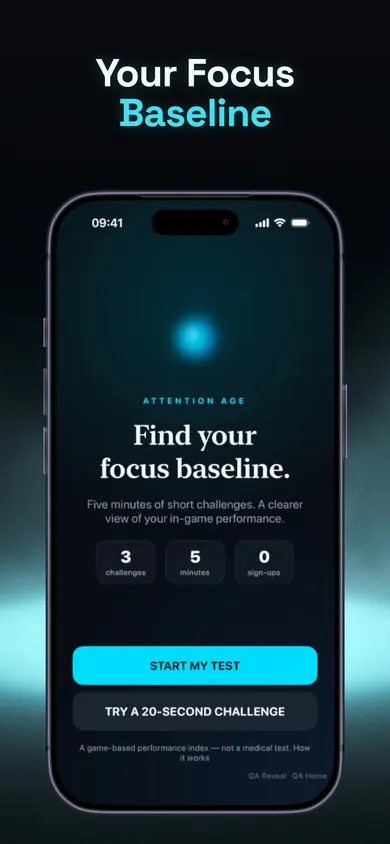
Attention Age start screen: 3 challenges, 5 minutes, 0 sign-upsno sign-up
Five minutes, no account.
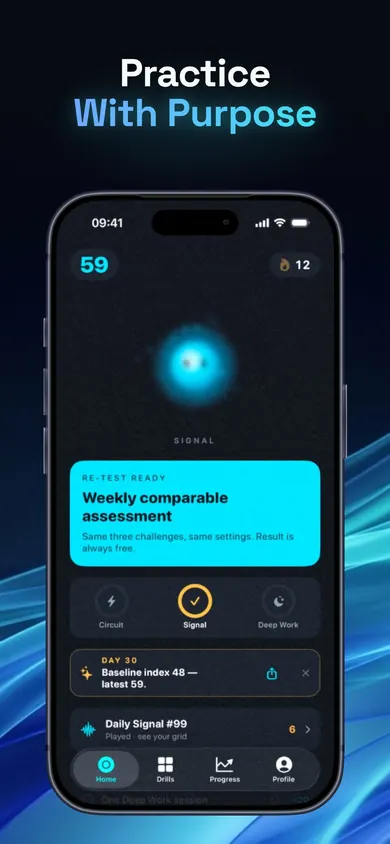
Weekly comparable assessment card: same three challenges, same settingssame tasks each week
The weekly re-test keeps the setup identical.
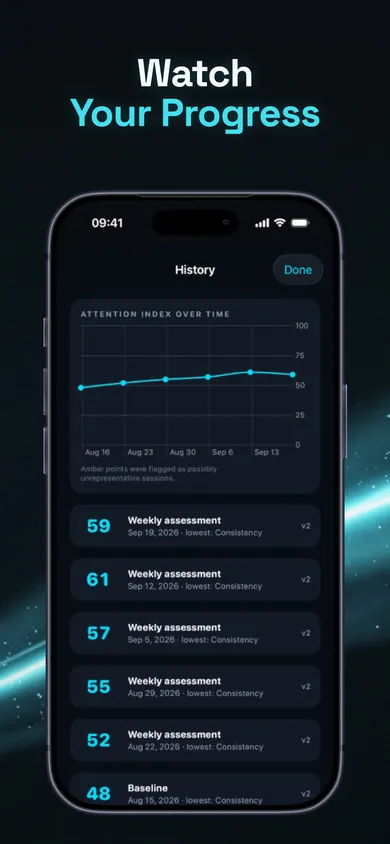
History of weekly assessment scores from 48 to 61dips stay visible
Lower results stay in the history too.
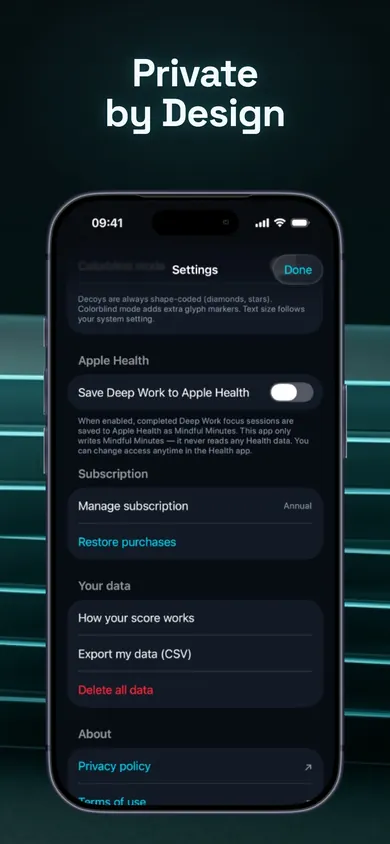
Settings with export data as CSV and delete all dataexport your history
Export your history as CSV, or delete it.

Honest limits

  • Attention Age measures how you do on its own tasks on your device. Its score is not an age, a percentile or a ranking, and it is not compared with any population (see the methodology page).
  • It is not a medical, clinical or diagnostic test, and a better score does not rule ADHD in or out.
  • The test, weekly re-tests and 10 or 25-minute focus sessions are free. Seven extra drills and 45 or 90-minute sessions need Pro, an optional monthly or annual subscription.

A design decision we argued about: weekly results are free forever. A before-and-after experiment should not stop halfway because of a paywall.

Who this page is not for

If you are struggling to keep a job, a relationship or your safety, skip the experiment and book the appointment now. If you already have an ADHD diagnosis, your care team is the right place to talk about phones and treatment.

This is general information, not medical advice. Talk to your clinician.

A Sunday-night version of this

It is 10:40 p.m. You meant to finish one email at 8. Instead, you have read half of four articles, answered two group chats and searched "is it ADHD or just my phone". Here is a calmer plan for Monday: tick the seven boxes above, screenshot the result, take one five-minute baseline, switch the alerts off. Two Mondays from now you will have something better than a late-night hunch: dates, notes and a few numbers to talk through with someone qualified.

Take your baseline tonight

Five minutes now, a fair re-test in a week. Open Attention Age in the App Store, or read the full listing first.

Download Attention Age: Focus Test on the App Store

Updated November 2026

Related