
Updated November 2026 · written for Black Friday, Friday November 27, 2026
Dear Black Friday shopper,
Two signs, one aisle. One says $20 off. The other says 20% off. You have about four seconds before someone with a trolley needs you to move. This letter is those four seconds, slowed down.
Is percent off or dollar off better?
Dollar off wins on cheaper items and percent off wins on pricier ones; the switch point is the dollar amount divided by the percent, so $20 off beats 20% off on anything under $100. That one division is the whole trick. Everything below is practice, traps and a small story.
The break-even rule for common Black Friday pairs
| Dollar deal | Percent deal | Break-even | Read it as |
|---|---|---|---|
| $20 off | 20% off | $100 | Under $100: $20 off wins |
| $50 off | 25% off | $200 | Under $200: $50 off wins |
| $15 off | 30% off | $50 | Under $50: $15 off wins |
| $10 off | 15% off | $66.67 | Under $66.67: $10 off wins |
| $100 off | 40% off | $250 | Under $250: $100 off wins |
Divide the dollars by the percent. Below that price, take the dollars.
Five percent-off traps worth spotting
- Stacked discounts don't add. 20% off, then an extra 10% at checkout, is 28% off, not 30%. The second cut comes off the smaller price.
- Buy one, get one 50% off is 25% off each, but only if they cost the same and you wanted two.
- Buy two, get one free is a third off three items. If you needed one, it's a pricier day out.
- "Up to 70% off" describes the best item in the sale, not the one in your hand.
- "Spend $100, save $20" is 20% only at exactly $100. Spend $140 to qualify and it's about 14%.
Who this page is not for
If you are buying a car, a sofa on finance or anything with interest attached, use a real calculator and read the terms; head math is for the aisle, not the contract. And if timed arithmetic makes your chest tighten, skip the game part of this letter entirely. The rule above works fine on paper.
How to do percent off in your head in 3 steps
- Find 10%. Move the decimal one place left. $64.00 becomes $6.40.
- Build the percent you need. 20% is double ($12.80). 30% is triple ($19.20). 5% is half ($3.20). 25% is just a quarter of the price ($16).
- Compare with the dollar deal, then round. $15 off or 30% off a $64 item? $19.20 beats $15. Round to the nearest dollar if the gap is big; compute exactly only if it's close.
A small Black Friday story
A shopper we'll call the blender person stands between two stores' offers on the same $79 blender: $20 off at one, 25% off at the other. The percent sounds bigger. A quarter of $79 is $19.75. The dollar deal wins, by a quarter. They laugh, take the $20, and spend the 25 cents on nothing in particular. Then, at checkout two days later on Cyber Monday (November 30), a $45 sweater offers 40% off or $15 off: 40% is $18, so the percent wins this time. Same person, same rule, different answer.
Neither kind of deal is "better". The price decides.
The worked receipt
Headphones, sticker$129.99
30% off (10% is $13.00, times 3)−$39.00
Price after first deal$90.99
Extra 10% at checkout−$9.10
You pay$81.89
Total saved: $48.10, which is 37%, not 40%.
Where SkillArena fits
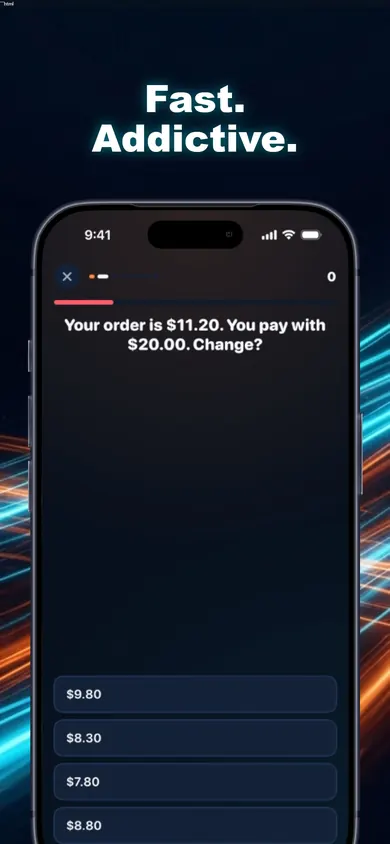
We make SkillArena, a free skill game. Its Calculation category is quick money arithmetic: working out change ("Your order is $11.20. You pay with $20.00."), estimating totals, and drills like Quick Deal and Receipt Rush in the training library. It won't teach you this page's percent rules, and we won't pretend it does. What it gives you is four minutes a day of the number habit that makes the rules fast.

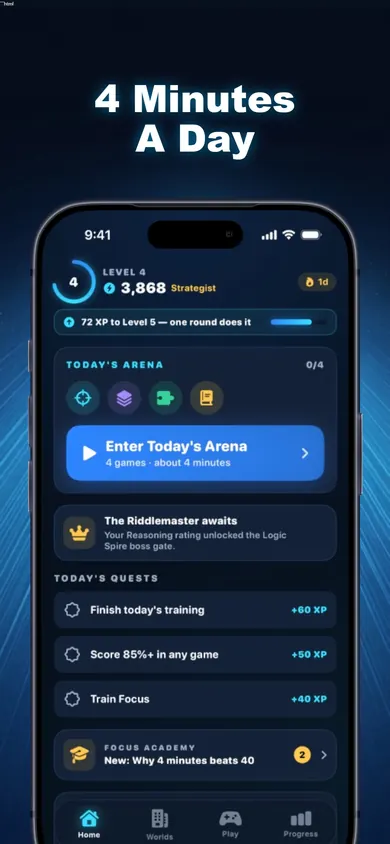
Honest limits: ratings describe your play inside SkillArena only, not an IQ or any clinical measure. A relaxed pace option gives longer timers if the clock feels like the checkout queue. One design decision we made: if you leave mid-round, the timer pauses, so a till that opens up never costs you a game.
Questions shoppers ask
Is $20 off better than 20% off?
Only on items under $100. At exactly $100 they are the same; above $100, 20% off saves more. The rule: divide the dollar amount by the percent (as a decimal) to get the break-even price.
How do I work out a percent off in my head?
Find 10% by moving the decimal one place left, then build from it: 20% is double, 5% is half, 25% is a quarter, 30% is three tens. For $64, 10% is $6.40, so 30% off saves $19.20.
Is 20% off plus an extra 10% off the same as 30% off?
No. The second discount comes off the already-reduced price, so it is 28% off in total. Two discounts of 30% then 10% give 37%, not 40%.
Is buy one get one 50% off the same as 25% off?
Yes, if both items cost the same and you wanted two. If you only needed one, it is a 50% discount on something you didn't plan to buy.
When is Black Friday 2026?
Friday, November 27, 2026, the day after Thanksgiving (Thursday, November 26). Cyber Monday is November 30, 2026.
Does SkillArena teach percentages?
We won't promise that. SkillArena's Calculation games train quick money arithmetic, like working out change and estimating totals. The percent rules on this page are the part you bring to the store.
Happy hunting, and may every sign be easy to divide,
The SkillArena team at Honest Little Apps
P.S. The four-minute warm-up costs nothing. Get SkillArena free before Friday: