 Mental math for beginners
How do you estimate a grocery total in your head?
Round each price to the nearest dollar the moment it goes into the cart, add that whole number to one running total, and adjust for tax and coupons only once, at the till. That's the whole method. The rest of this page is a playable basket round, the reasoning behind it, and the small traps that throw beginners off.
Proof screenshots: where this lives in SkillArena
SkillArena has a Calculation category with real-money games. The Training Library lists two of them by name, Quick Deal and Receipt Rush, and the listing describes "estimate totals" among its thirteen games. Here's what that looks like on the phone.
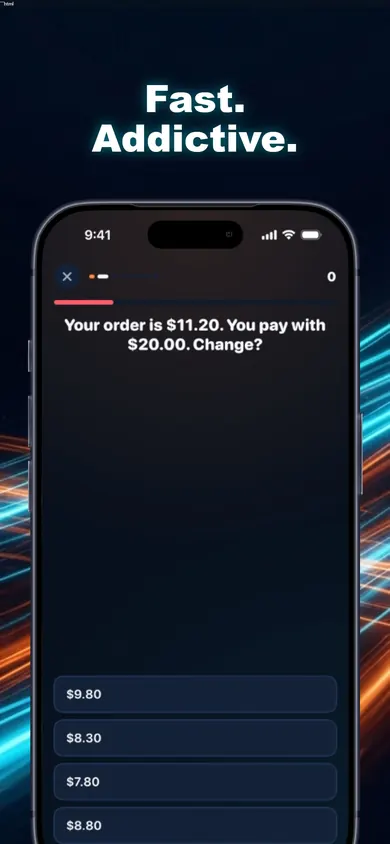

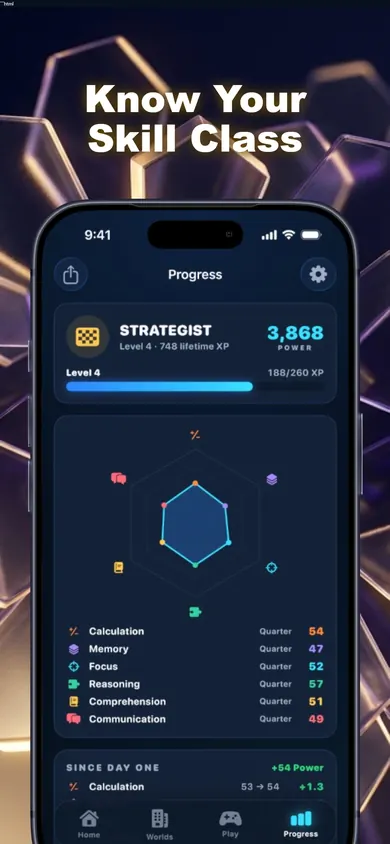
Play a basket round: estimate the total
Six items go into the cart one at a time. Each price shows for a moment, then hides, the way it does once a jar is in the trolley. Keep a rounded running total in your head, then pick the closest total.
Your running total starts at zero.
Why rounding to the nearest dollar works
Each rounding is wrong by at most 50 cents, and in a mixed basket some go up while others go down. Six items rounded to the nearest dollar will usually land within a dollar or two of the real total, which is close enough to decide whether to put the second bag of coffee back.
The method breaks in one predictable place: prices that all end in .99 or .89. Rounding $2.99 to 3 is fine, but if every price in the cart ends that way, you are always rounding up by a cent or a dime, and the error stacks in one direction. In a cart full of .99s, you'll be a little high, which is the safe way to be wrong.
Round as it goes in, say one number, check once at the till.
Mental math for groceries: five traps beginners hit
- Keeping two totals. Dollars in one hand, cents in the other. Drop the cents entirely; one number is easier to hold while you're reading labels.
- Forgetting the multipack. "4 for $5" is $5 for four. Add 5, not 1.25.
- Per-pound prices. Use the weighed label. If there isn't one yet, round the weight and the price and multiply.
- Adding the discount early. Coupons and loyalty prices go at the end, as one subtraction.
- Re-adding from scratch. If you lose the number, don't restart. Count items and multiply by a rough average, then carry on.
Grocery estimating questions
What is the easiest way to estimate a grocery total?
Round every price to the nearest whole dollar as it goes into the cart, add that whole number to one running total, and say the total once in your head. $3.49 becomes 3, $3.50 becomes 4, $0.99 becomes 1.
Should I round up or round to the nearest dollar?
Nearest dollar is the most accurate on a typical basket because the ups and downs tend to cancel. If you are shopping to a hard limit, round every price up instead: your estimate will land a little high, which is the safe side.
How do I handle items sold by weight?
Use the price on the scale label or shelf tag after weighing, not the per-pound price. If you haven't weighed it, multiply roughly: 2.4 lb at $1.99/lb is about 2.5 × 2 = $5.
What about sales tax and coupons?
Keep them out of the running total and adjust once at the end. Many stores don't tax most groceries, but rules vary by state and item, so check your own receipt once to learn the pattern.
Is SkillArena a grocery budgeting app?
No. SkillArena is a skill game. Its Calculation category includes games such as Quick Deal and Receipt Rush, and the listing describes estimating totals among its 13 games. It won't track your spending.
Is SkillArena free?
It is free to download, with no ads and no account. When we checked the App Store page in November 2026 it did not list any in-app purchases.
Honest limits
Our basket round above is a teaching toy; SkillArena's own Calculation games are different questions with four answer choices, and every question is generated fresh. Neither will track what you actually spend. If you want a running receipt on your phone, a shopping list or budgeting app will serve you better.
SkillArena is a game. Its ratings describe how you play its own games and are not an IQ score or any kind of assessment. One design decision we made: leaving the app mid-round pauses the timer, so a toddler grabbing the trolley doesn't cost you the round. One limitation: the default timers are short; turn on the relaxed pace option if they stress you out.
How it works in 3 steps
- Open Today's Arena. Four short, different games in about four minutes, mixed across categories including Calculation.
- Play the Calculation games. Estimate totals, work out change, compare deals. Difficulty adapts to how you play.
- Watch the Calculation rating. The Progress tab shows a 1 to 100 rating per category and exactly how it's calculated.
Make it a habit with SkillArena
Four minutes a day, a few real-money questions mixed in, and the grocery total gets quicker on its own. Make it a habit with SkillArena, free on iPhone.
