How do you make brain games a daily habit?
Make the session small enough to fit on your worst day, tie it to something you already do, and count days per week instead of an unbroken streak so one miss doesn't end it. That's the whole method. The rest of this page is what it looks like over one real-feeling week.
A habit is built on Friday, the day after you missed one.
A week in the story: building a brain game routine
Meet our made-up reader: works full-time, has tried two brain apps before, deleted both by the second week. This time the rules are different: six minutes, one cue, no streak.
- Mon
Pick the cue, not the time
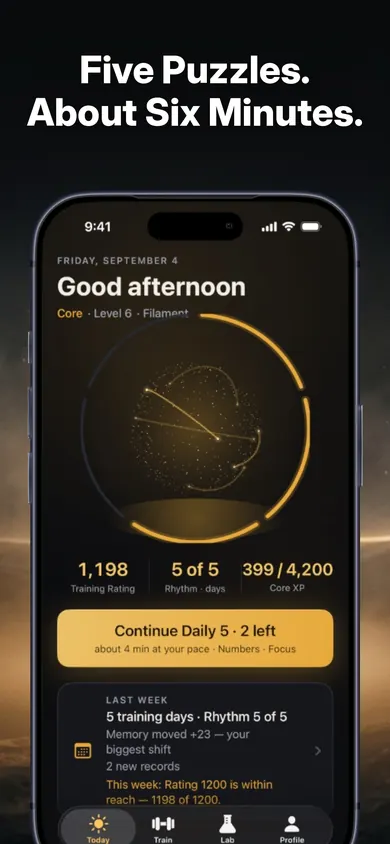
The cue is "kettle on". While it boils: open Cognilo, start the Daily 5. The first puzzle starts straight away, with no sign-up and no questionnaire. Five short rounds, about six minutes.
- Tue
Read the tip, skip the score
After each round there is a strategy tip for that game and a note on pace versus accuracy. Today's tip on Pattern Recall is more useful than the number next to it.
- Wed
Let it adapt
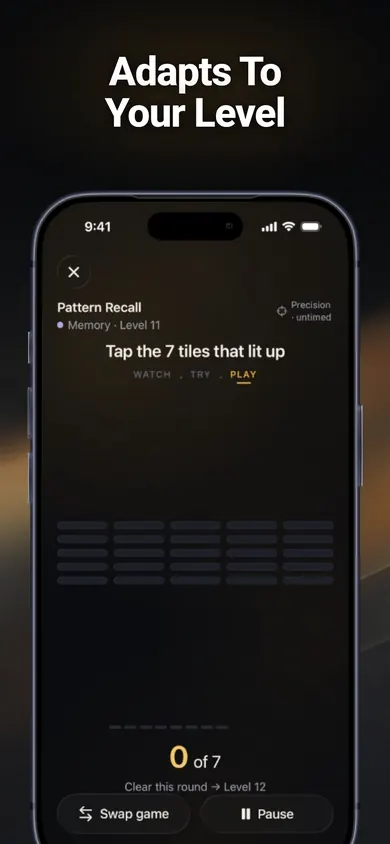
Rule Chain felt too easy. Telling Cognilo so means the next one responds. Every round is set to the current level and shows a plain-language reason for why it was picked today.
- Thu
The miss
Late meeting, no kettle, no puzzle. In every previous app this was the day it ended. Here the week just shows four days instead of five.
- Fri
The day that matters
Back at the kettle. Nothing to repair, no streak to mourn. This is the moment most habits die, and the reason we count Rhythm in days per week.
- Sat
Untimed, on purpose
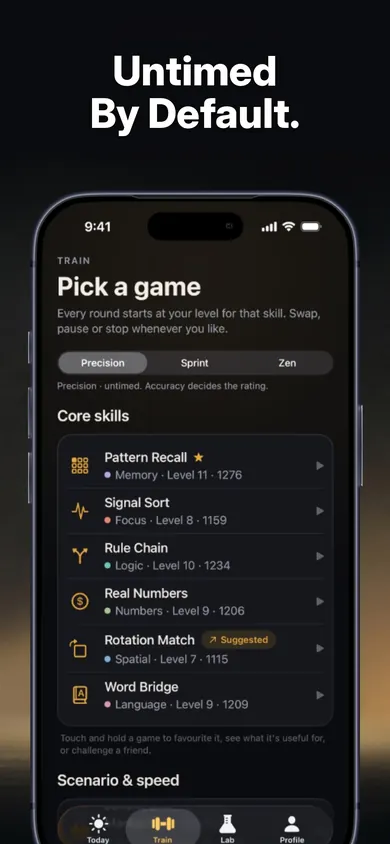
Weekend brain is slow brain. Precision mode is untimed by default; Zen is unrated for days you just want to play. Market Run shows up and takes a little longer than usual.
- Sun
Grace, then a look back
Away for the day. Grace covers it. In the evening: five sessions, six skills tracked separately, ratings that only move when several sessions agree.
Count the week, not the chain.
Try it: your six-minute slot
Pick the cue you already have. We'll write the one-line plan you can stick on the fridge.
Choose a cue above.
Comparison strip: streaks vs days per week
| Unbroken streak | Cognilo Rhythm | |
|---|---|---|
| What counts | Consecutive days | Days played this week |
| One missed day | Back to zero | One fewer day this week |
| Busy weeks, holidays | Usually a reset | Grace and Vacation cover them |
| Best for | People who love an unbroken chain | People who quit after a break |
Why we chose it: the UCL habit study (2009) found that missing one opportunity did not significantly affect habit formation, while very inconsistent behaviour did not become a habit. Days per week rewards consistency without punishing a single miss. Updated November 2026.
Who this is not for
If you love streaks and they keep you going, keep them; plenty of puzzle apps use them well. If you want a long session to sink into for an hour, a crossword or logic puzzle book will feel better. And if you are worried about memory changes, talk to a clinician first. This is general information, not medical advice.
Honest limits
- A week isn't a habit. The UCL study's average was 66 days, with a wide range.
- Getting better at Cognilo puzzles shows you got better at Cognilo puzzles. The listing says ratings are not a measure of intelligence or health.
- The free tier is complete for daily play. Pro (monthly or annual) adds Pressure Response and Interference in the Performance Lab, weekly and monthly reports, and up to 12 months of rating history.
- Purchases, restores and optional Game Center leaderboards need a connection; daily play does not.
How it works in 3 steps
- Open and play. No account. The Daily 5 picks five of six categories (memory, focus, logic, numbers, spatial, language) and rotates them across the week.
- Read the tip. Each round ends with a strategy tip and an unrated Review replay of anything that slipped.
- Check the week. Rhythm shows days per week. Ratings move only when several sessions agree.
Daily brain game habit questions
How long does it take to make brain games a habit?
Longer than a week. In the UCL habit study published in the European Journal of Social Psychology, it took 66 days on average for a daily behaviour to feel automatic (UCL, 2009). Plan for the first week to feel deliberate.
Do streaks help or hurt a brain game habit?
They help some people and push others to quit after one broken day. The same UCL study found missing a single opportunity did not significantly affect habit formation, which is why Cognilo counts days per week (Rhythm) instead of an unbroken streak.
How many minutes a day of brain games is enough for a habit?
For habit purposes, short wins. Cognilo's Daily 5 takes about six minutes at a typical pace. A session you can always fit beats a longer one you postpone.
What time of day is best for daily brain games?
Whatever time already repeats in your day: after the first coffee, on the train, before you open email. Attach the game to a cue you never skip.
Will daily brain games protect my memory as I age?
We do not claim that. A 2016 review in Psychological Science in the Public Interest found training improves the trained tasks, with little evidence for everyday cognitive benefits. Cognilo's ratings describe how you play its puzzles, not intelligence or health.
Is Cognilo free to use every day?
Yes. The free tier includes the Daily 5, all six skills, ratings, the Benchmark and achievements. Cognilo Pro is an optional monthly or annual subscription for the Performance Lab extras, weekly and monthly reports and longer rating history.
Start your first Daily 5
Six minutes, one cue, no streak to protect. Open Cognilo in the App Store.

Related
- Cognilo: five daily brain training gamesFree brain training games for adults: five untimed puzzles a day, about six minutes, adapted to your level. No account, no ads, works offline.
- Brain games for retirees: where six minutes of puzzles fit in a weekNewly retired? What brain games can and can't do, what the NIA says about staying sharp, and a week planner that puts puzzles in their place.
- How long to do brain games each day: calculator and guideHow many minutes of brain games a day is enough? A calculator for your week, what a 10-year NIH-funded trial used, and a 6-minute daily routine.
- Untimed brain games for adults: find your mode in 3 tapsTimers make you freeze? Three taps match you to an untimed brain game mode and a first puzzle in Cognilo, free on iPhone. No clock unless you want one.