Open Today
Your first puzzle starts straight away, with no sign-up. Five rounds picked for your level, from memory, focus, logic, numbers, spatial and language.
Problem: no idea how long
For anyone unsure how long brain games should take: enter your days, see your week in Daily 5s.
Brain game time calculator
30 min a week
That's 5 Daily 5s: 25 rounds across Cognilo's six skills.
 Free on iPhone · no account
Five to ten minutes a day, on most days, is a sensible target for brain games; there is no proven daily dose, so pick the length you will still be doing next month. Cognilo's Daily 5 is built around that: five short puzzles, about six minutes at a typical pace, and a Rhythm that counts days per week rather than punishing a missed one. Updated November 2026.
Store screenshots, stacked in the order you'd see them.
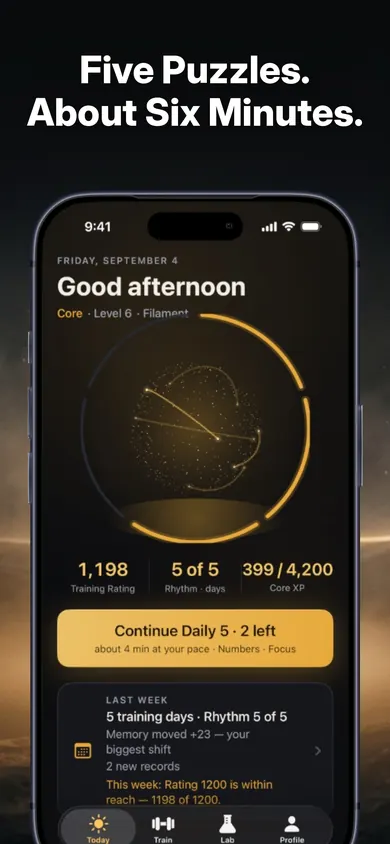
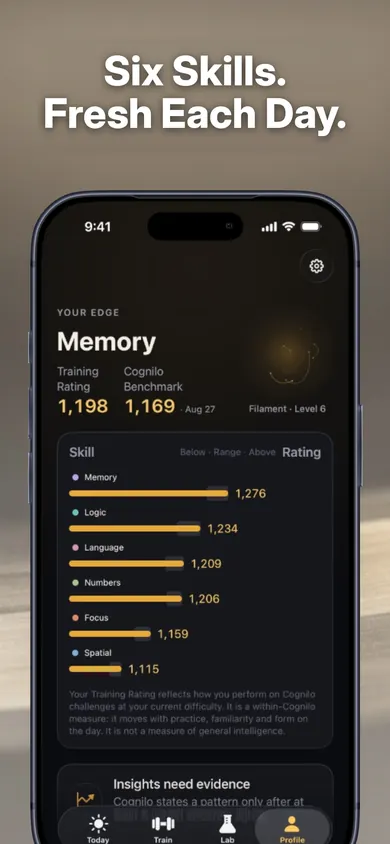
The number above is honest arithmetic, not a prescription. At the default 6 minutes and 5 days you'd play 30 minutes a week, or 25 puzzle rounds. Each Daily 5 plays five different categories out of six and rotates, so every skill comes round across the week.
For scale, ACTIVE, a large NIH-funded trial of cognitive training in 2,832 older adults, gave each training group 10 sessions of 60 to 70 minutes over about five to six weeks, roughly 10 to 12 hours, with some booster sessions later (NIH (2014)). Ten years on, more people in the reasoning and speed-of-processing groups were still above their starting level on those skills than in the control group; memory training showed no lasting difference, and standard tests of daily function didn't differ between groups.
Put in Cognilo terms: at 6 minutes a day, 5 days a week, reaching ACTIVE's 10 to 12 hours would take roughly 20 to 24 weeks. Slower, and much easier to fit around a life.
Minutes are easy to count; what transfers to everyday life is much harder to prove.
This is general information, not medical advice. Talk to your clinician.
30 min a week. Fits beside coffee. Ratings move only when several sessions agree, so one off day doesn't matter.
Same 30 minutes. Easier to skip, harder to pick up again, and one tired evening carries the whole week.
We'd pick the first. The research doesn't settle it either way for apps, but habits are easier to keep in small pieces, and the Daily 5 is built for exactly that.
Your first puzzle starts straight away, with no sign-up. Five rounds picked for your level, from memory, focus, logic, numbers, spatial and language.
Precision is untimed by default. Sprint adds a clock for a push. Zen is unrated. Each puzzle shows why it was picked today.
After each round you get a strategy tip and notes on pace versus accuracy. Then close the app. Six minutes is the point.
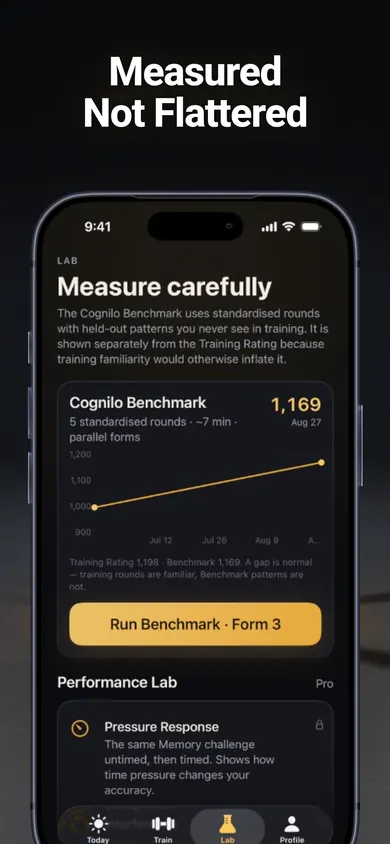
One design decision we made: the Cognilo Benchmark uses held-out rounds you never train on, so playing longer each day can't flatter your Benchmark score through familiarity alone.
Days with the longer Market Run shopping scenario take a little more than six minutes. Weekly and monthly reports and 12 months of rating history are part of Cognilo Pro ($9.99 a month or $44.99 a year on the App Store); the Daily 5, all six skills, ratings and the Benchmark are free. If you want long, deep puzzle sessions, a dedicated sudoku or crossword app suits that better.
There is no proven daily dose for brain games. A short session you repeat most days is easier to keep than a long one you abandon. Cognilo's Daily 5 takes about six minutes at a typical pace.
Enough for what matters most: playing regularly and getting better at the puzzles. Claims that a set number of minutes will improve everyday life are not well supported; the FTC (2016) fined Lumosity's maker $2 million in 2016 over claims like that.
According to the NIH (2014), groups had 10 sessions of 60 to 70 minutes over about five to six weeks, some with later booster sessions. Reasoning and speed training effects were still measurable after 10 years; memory training was not different from controls.
Yes. Once the Daily 5 is done you can pick any game in Train, choose untimed Precision, timed Sprint or unrated Zen, and play as long as you like.
Not in Cognilo. Rhythm counts days per week instead of an unbroken streak, and Grace and Vacation cover busy weeks.
Once it has seen a few of your rounds, Cognilo shows your own estimate before you start the Daily 5.
Six minutes today, six tomorrow, or skip a day and come back. Get Cognilo free on iPhone.