What do brain game scores actually measure?
A brain game score measures how well you played that app's games, at that difficulty, on that day; it is a record of performance, not a reading of your intelligence or brain health. Scores from different apps use different scales, so compare a score only with your own earlier scores in the same app.
Same app, same kind of round, several days: that is the only fair comparison.
Who this glossary is not for
If you are worried about memory changes in yourself or a parent, a game score is the wrong tool; talk to a clinician. This is general information, not medical advice. Talk to your clinician. If you want one IQ-style number to compare with friends, no honest brain game will give you that. And if you just want to play and never look at a chart, Cognilo has an unrated Zen mode and you can skip this page entirely.
Mini story: the Thursday jump
Picture someone on their fifth morning of Cognilo. Rule Chain has been stubborn all week, then on Thursday the Training Rating jumps by more than they have ever seen. The temptation is to screenshot it and call it proof.
Instead they run the Benchmark that weekend: five standardised rounds made from patterns they have never trained on. It moved, but less, and the app shows a gap between the two numbers and calls that gap normal. The honest reading: some of Thursday was familiarity, some was real. The next three weeks decide which part stays.
A jump is a question. Three more sessions are the answer.
Brain game score terms, explained like a chat
Twelve terms in the order you are likely to need them. Our app is Cognilo; we name its terms where they differ from the general ones.
Practice effect
Scores rise when you repeat a task, partly because you learn the task itself: its timing, its tricks, where to look. It is real improvement at that game, and the most common reason a score jumps in week one.
A jump in week one is mostly the game getting familiar.
Familiarity
The narrow version of the practice effect: you have seen these exact patterns or questions before. Cognilo's Benchmark exists to strip this out by using rounds you never train on.
Held-out rounds
Puzzles kept out of training and used only for measuring. If your score rises on rounds you have never practised, familiarity cannot explain it. The Cognilo Benchmark uses held-out rounds.
Held-out rounds are the fairest mirror an app can hold up.
Parallel forms
Different versions of a test built to the same difficulty, so a retest is not a rerun. Cognilo's Benchmark runs in numbered forms (the screenshots show Form 3).
Day-to-day noise
Sleep, coffee, mood and a noisy room move any score a little. A single good or bad morning is usually noise, not a trend.
Regression to the mean
A statistical habit of numbers: an unusually high score tends to be followed by a more ordinary one, and an unusually low one by a better one, with no change in you at all.
Your best day is rarely your new normal.
Training Rating
Cognilo's within-app measure of how you play its challenges at your current difficulty. The app says it moves with practice, familiarity and form on the day, and is not a measure of general intelligence.
Performance Rating
Cognilo's per-skill rating that only moves when several sessions agree, so one good morning or one tired evening does not rewrite your profile.
Lumosity Performance Index (LPI)
Lumosity's own score. Its help page describes LPI as a standardized scale calculated from all your recorded game scores; your overall LPI is an average of your game LPIs.
Near transfer
Getting better at tasks that closely resemble the one you trained. A large review found less evidence for this than for gains on the trained task itself.
Far transfer
Getting better at different, everyday tasks because you trained on a game. The 2016 review by Simons and colleagues found little evidence for it.
Better at the game is proven; better at life is not.
Rhythm
Cognilo counts training days per week instead of an unbroken streak, with Grace and Vacation for busy weeks. A missed Tuesday does not reset anything.
How score systems compare
| Score | Built from | Practice can inflate it? |
|---|---|---|
| Lumosity LPI | All your recorded game scores, on a standardized scale (per Lumosity's help page) | Yes, like any training score |
| Cognilo Training Rating | How you play at your current difficulty | Yes, and the app says so |
| Cognilo Performance Rating | Several sessions that agree | Less: one good day can't move it alone |
| Cognilo Benchmark | Held-out rounds in parallel forms | Least: you never train on them |
Lumosity details are from its public help page, checked November 2026. We make Cognilo.
What these terms look like in Cognilo
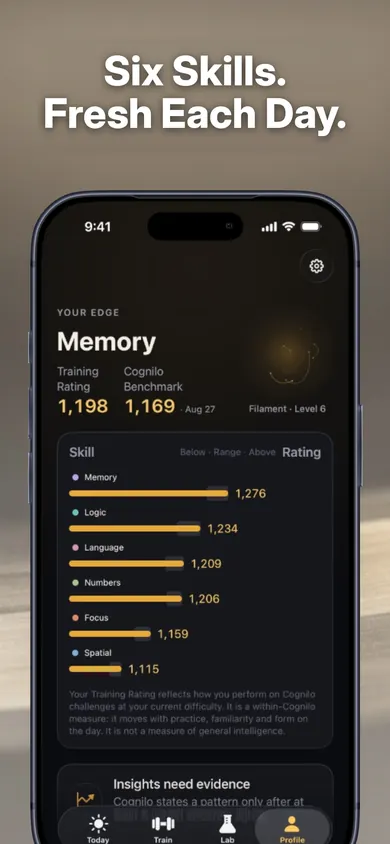
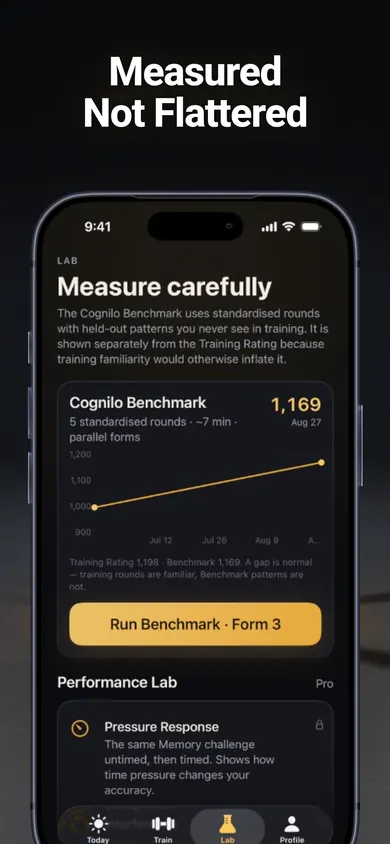
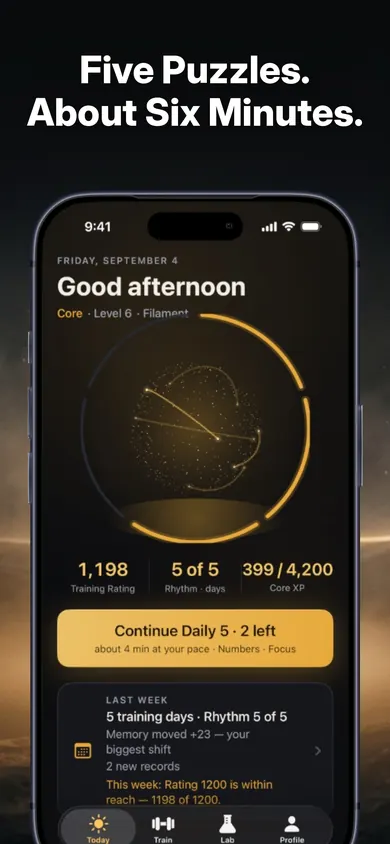
How to read a score jump in 3 steps
- Count your sessions. In the first week or two, expect jumps. That is the practice effect doing its job.
- Check a held-out measure. In Cognilo, run the Benchmark. If it moved too, more of the jump is likely to be real skill at these puzzles.
- Wait for agreement. Look again after several sessions. If it holds, it is a trend; if it slides back, it was a good day.
Your three-tap result, decoded
The check at the top adds up three signals. Early sessions plus trained puzzles plus a single day points to practice and noise. Mixed answers point to too early to tell. Many sessions, a held-out benchmark and a jump that has held for a week point to a real trend in this game.
Even the best result means "better at these puzzles". The 2016 review by Simons and colleagues found strong evidence that training improves trained tasks and little evidence for everyday performance, and the National Institute on Aging (reviewed 2024) says there is not enough evidence that commercial brain-training apps match the effects seen in the ACTIVE trial.
One design decision we made: Cognilo's Training Rating and Benchmark are always shown separately, even when the gap makes the Benchmark look worse. One limitation: the free tier keeps your current ratings; weekly and monthly reports and up to 12 months of rating history are part of the optional Cognilo Pro subscription.
Questions about brain game scores
Why did my brain game score jump so much?
Usually the practice effect: you have learned the task. Day-to-day noise and regression to the mean add to it. A jump on held-out rounds, repeated over several sessions, is the more convincing kind.
Why did my brain training score drop?
A tired day, a harder difficulty level, or regression after an unusually good session. Cognilo's Performance Ratings only move when several sessions agree, so one bad evening does not rewrite them.
What is a good LPI on Lumosity?
Lumosity describes LPI as a standardized scale from your recorded game scores, useful for comparing your strengths across games. Its help page focuses on your own pattern, so treat it as a map of your play rather than a grade.
Do higher brain game scores mean I am getting smarter?
Not necessarily. A 2016 review in Psychological Science in the Public Interest found strong evidence for gains on trained tasks and little for everyday cognitive performance. The National Institute on Aging says there is not enough evidence that commercial brain-training apps match the ACTIVE trial's effects.
What is the Cognilo Benchmark?
Five standardised rounds, about seven minutes, in parallel forms made from held-out patterns you never see in training. It is shown separately from your Training Rating, and it is part of the free tier.
Are brain game scores comparable between apps?
No. Each app builds its scale from its own games and its own players or rules. Compare an app's score only with your own earlier scores in the same app.
Download free on the App Store
Five puzzles, about six minutes, untimed by default. The Daily 5, all six skills, ratings and the Benchmark are free. Download free on the App Store.

Download Cognilo free on the App Store · Updated November 2026
Related
- Cognilo: five daily brain training gamesFree brain training games for adults: five untimed puzzles a day, about six minutes, adapted to your level. No account, no ads, works offline.
- A free Lumosity alternative? Eight questions answered, checked November 2026Looking for a free Lumosity alternative? What Lumosity, Peak and Cognilo give free users, checked November 2026, and who should pick which.
- How to make brain games a daily habit, without streak guiltA week-long story of making brain games a daily habit: a six-minute slot, days-per-week instead of streaks, and what to do on a missed day.
- Brain games for retirees: where six minutes of puzzles fit in a weekNewly retired? What brain games can and can't do, what the NIA says about staying sharp, and a week planner that puts puzzles in their place.