 Sustained attention test
What is a sustained attention test?
A sustained attention test asks you to repeat one easy rule many times, then counts the moments you slip into autopilot. The classic version is the SART from Robertson and colleagues in Neuropsychologia (1997): digits 1 to 9, respond to all of them, hold back on 3. Most slips are not about speed. They happen when your thumb keeps the rhythm and your mind has gone elsewhere.
Drift is ordinary. In a smartphone sampling study by Killingsworth and Gilbert in Science (2010), people's minds were wandering in 46.9% of the moments sampled. A short test simply makes the drift visible for a minute.
| Number | What it counts | What it hints at |
|---|---|---|
| Slips | Taps on a 3 | Responding on rhythm instead of checking |
| Misses | Digits you let pass | Drifting so far you stopped responding |
| Average time | Milliseconds from digit to tap | Pace; faster is not always better here |
| Wobble | How much your timing varies | Uneven attention across the round |
Fast average plus several slips is the classic autopilot pattern: quick, smooth and not quite looking.
The longer version, on your iPhone
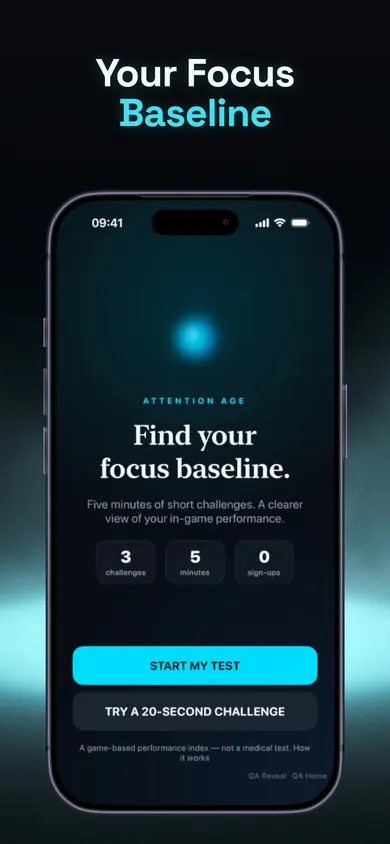
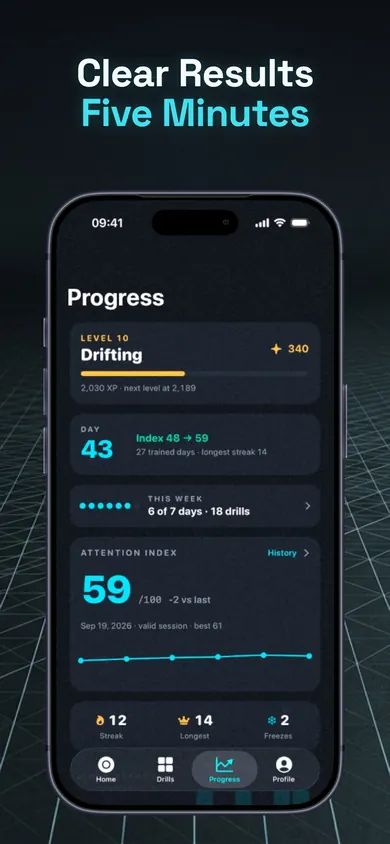
Attention Age turns the same idea into a five-minute session with three tasks: Signal Watch (tap the signals, skip the decoys), Interference and Tracking.
How to use a sustained attention test well
- Pick one fixed slot. Same device, same hand, roughly the same time of day. A 9 a.m. score and a 4 p.m. score are different questions.
- Read slips before speed. Two slips at 380 ms tells you more than a lone fast average.
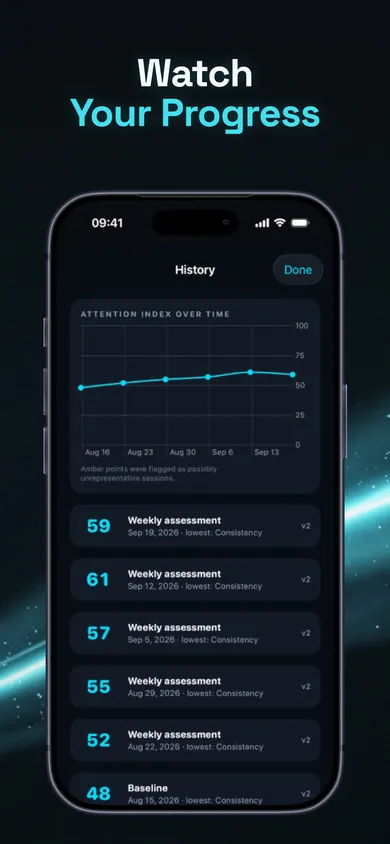
- Re-test weekly, not hourly. Attention Age's weekly re-test uses the same tasks and scoring and calls any change under 5 points "about the same".
This demo vs the lab SART vs the app
This page
40 digits, about 50 seconds, results gone when you close the tab. A taste.
Lab SART
225 digits, about five minutes, used in research. PsyToolkit's open SART version runs it free on a computer.
Attention Age
Three tasks in five minutes, five category scores, a validity check and a saved history on your iPhone.
A 2:40 p.m. example
You open a report, read the same paragraph twice and reach for the phone. Instead, you run the 40 digits. Three slips, one miss, a quick average. That reads as autopilot, not exhaustion. So you name one task, start a 25-minute Deep Work countdown and leave the phone face down. Next Tuesday, same slot, you test again and compare like with like.
Honest limits
- This demo has no norms. Your numbers are only comparable with your own later runs on the same device.
- Attention Age's Attention Index is not an age, a percentile or a ranking, and it is not compared with any population (see our methodology page).
- Neither is a medical, clinical or diagnostic test. Scores usually rise with practice, which shows improvement at the tasks, not proof of broader change.
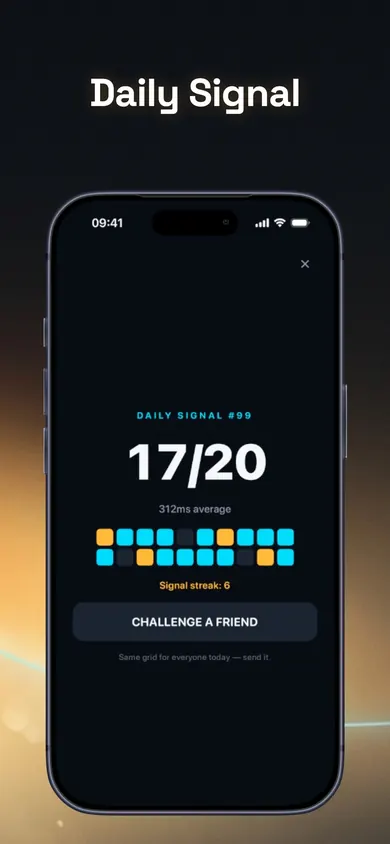
- Free: the test, weekly re-tests, Daily Signal, three practice tasks, 10 and 25-minute focus sessions. Pro (monthly or annual): seven more drills and 45 or 90-minute sessions.
We built the scratch card on purpose: you see slips before speed, because that is the number most people skip.
If you want a clinical assessment, see a clinician. If you only want a timer, any focus timer will do.
Sustained attention test FAQ
What is a sustained attention test?
A task that asks you to keep the same simple rule going for long enough that your mind starts to drift. The best-known one, the Sustained Attention to Response Task (SART) from Robertson and colleagues in Neuropsychologia (1997), shows digits 1 to 9 and asks you to respond to every digit except 3.
What does tapping on a 3 mean?
That you were responding on rhythm rather than checking each digit. Researchers call it a commission error. One or two in a short round is common; the useful thing is whether the count changes when you are rested, tired or interrupted.
How long is a real SART?
The original uses 225 digits and takes about five minutes. PsyToolkit's open SART version shows each digit for 250 ms followed by a 900 ms mask. Our browser demo is a 40-digit taste of the same idea.
Is this an ADHD test?
No. Neither this demo nor Attention Age is a medical, clinical or diagnostic test. If attention problems affect your work or home life, talk to a clinician.
Is there a free sustained attention test on iPhone?
Attention Age's five-minute test includes Signal Watch, a tap-the-signal, skip-the-decoy task, alongside Interference and Tracking. The test, the weekly re-test and the Daily Signal are free; extra drills and 45 or 90-minute focus sessions need the optional Pro subscription.
Run the full five minutes
Three tasks, a clear score, and a weekly re-test that compares fairly. Download free on the App Store, or open the listing.

Updated November 2026
Related
- Attention Age: a five-minute attention span testA five-minute attention span test for iPhone: three timed tasks, a 0-100 Attention Index explained in plain language, then daily practice.
- The flanker test explained, step by step (with a 12-trial demo)What the flanker (arrow) test measures, what each screen asks, and what your interference cost means. Try a 12-trial demo in your browser.
- A focus test for adults over 50, screen by screenA screen-by-screen guide to a five-minute focus test for adults over 50: what each number means, what it can't tell you, and when to see a doctor.
- Free ADHD attention tests online: 6 myths vs factsCan a free online attention test tell you if you have ADHD? Six myths vs facts with CDC, NIMH and Mayo Clinic sources, plus what a 5-minute test can show.