For adults 50+ who want to check their focus at home: a timed test you compare only with yourself.
Tap a card to flip it.
Free on iPhone · no account
Is there a good focus test for adults over 50?
The most useful focus test after 50 is a short, timed one you repeat under the same conditions and compare only with your own earlier results. Attention Age does that in five minutes on iPhone. It is a self-check, not a medical test, and it says so on the first screen.
This page walks through the real screens, one by one, with notes on what each number means for someone who is not 22 and does not want to be graded like it. Updated November 2026.
Questions adults over 50 ask first
Is there a focus test for adults over 50 I can take at home?
Yes. Attention Age is a five-minute set of three timed tasks on iPhone with no account. Researchers have also built longer home tests for this age group, such as the 20-minute online test of memory and attention described by Troyer and colleagues in Frontiers in Aging Neuroscience (2014). Neither is a diagnosis.
Does a lower score mean my memory is going?
No. Attention Age measures how you did on three specific tasks on that day and that phone. It does not test memory and is not compared with anyone else. If you are worried about memory, the National Institute on Aging (reviewed 2023) suggests talking with a doctor, especially if problems last more than a few weeks.
Is 'Attention Age' my brain age?
No. Despite the name, the app does not give you an age, a percentile or a ranking. You get a 0 to 100 Attention Index for those tasks and five category scores explained in plain words.
What if my eyesight or hands slow me down?
That will show up in a timed test, which is why we tell you to compare yourself only with yourself, under the same conditions. In the app, decoys are always shape-coded as diamonds and stars, a colorblind mode adds extra markers, and text size follows your iPhone's setting. Wear the glasses you read with.
Is the test free?
Yes. The test, the weekly re-test, the Daily Signal and practice of the three core tasks are free. Attention Age Pro (on the App Store today at $12.99 a month or $69.99 a year, with a 7-day trial on the annual plan) adds seven extra drills and 45 and 90-minute focus sessions.
How often should I re-test?
Once a week is plenty. The weekly re-test uses the same tasks and scoring, changes under 5 points are labeled 'about the same', and early gains that come from getting used to the tasks are flagged.
This is general information, not medical advice. Talk to your clinician.
The focus test, screen by screen
Store screenshots with our notes. The numbered dots match the notes beside each one.
123
Stop 1 · Before you start
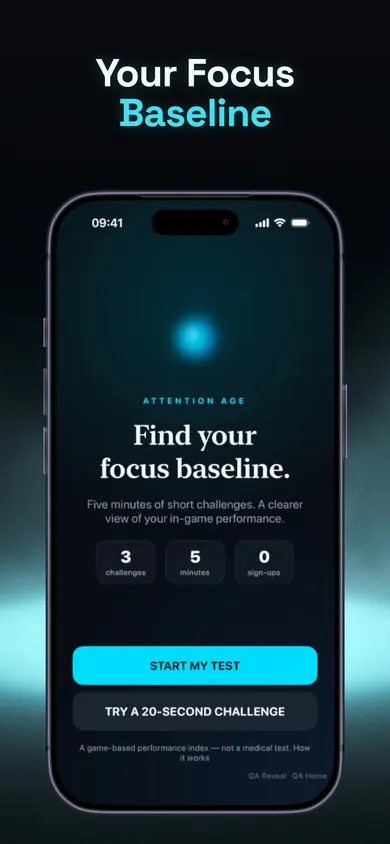
Three challenges, five minutes, zero sign-ups
The promise in numbers. Three timed tasks, about five minutes, and no account. Nothing to type in, no email.
Start my test. Sit where you'd read a book: good light, phone at your usual reading distance, reading glasses on if you use them.
Try a 20-second challenge. Not ready? Do this first. It lets your thumbs learn the taps before anything counts.
Same chair, same glasses, same time of day: that is how a home test becomes fair to you.
123
Stop 2 · Your result
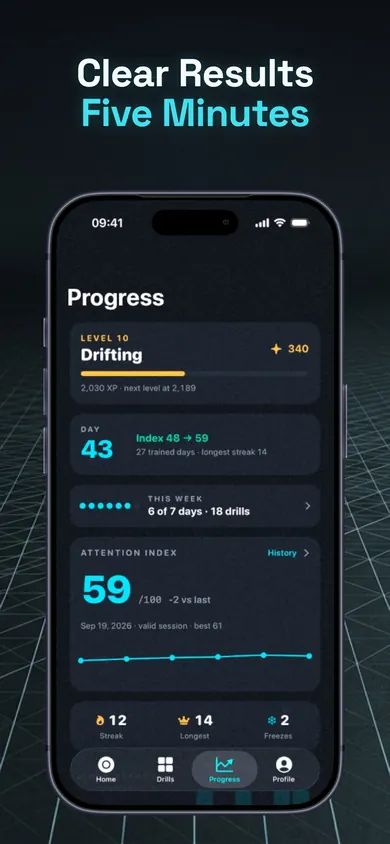
A 0 to 100 index, and what to ignore
The Attention Index. One number for this session on these tasks. It is not an age and it is not compared with any population.
"-2 vs last" and the line. The only comparison that matters is you against you. A two-point dip is noise, not news.
This week's dots. Days trained and drills done. Useful for habit, irrelevant to how sharp you are.
Behind the index sit five category scores: Sustained Attention, Response Control, Consistency, Distractor Handling and Object Tracking, each in plain language, plus your strongest category and one suggested practice focus.
123
Stop 3 · Week after week
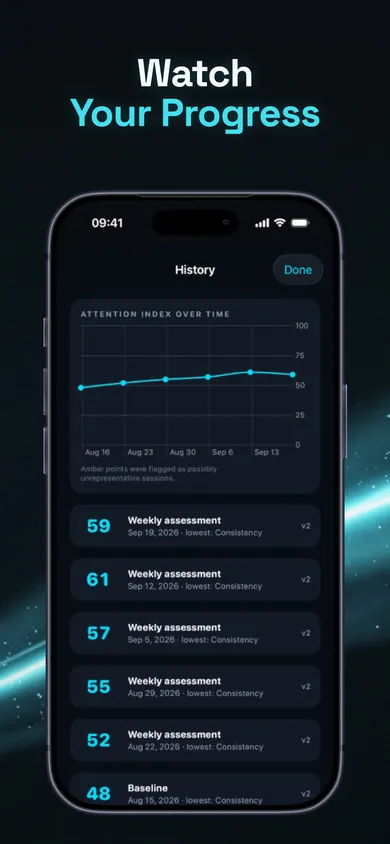
The re-test that keeps lower scores
The weekly chart. Same tasks, same scoring, any day you like. Weekly results are free.
Amber points. Sessions the app thinks may not reflect a real attempt (a phone call mid-test, say) are flagged.
Your baseline stays. Every result is kept, including the lower ones. Changes under 5 points are called "about the same".
A history that keeps your bad days is the only kind worth trusting.
123
Stop 4 · Settings worth a look
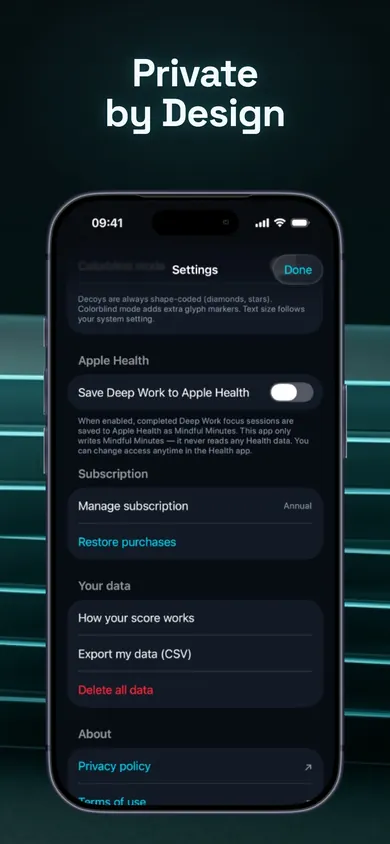
Readable, private, and yours to delete
Shapes, not only colors. Decoys are always diamonds or stars, a colorblind mode adds extra markers, and text follows your iPhone's text size.
Export my data (CSV). Want to show your doctor a few months of results? Export the file and bring it.
Delete all data. One tap clears everything. There is no account and no third-party analytics.
A mini story: the Sunday-morning check
Picture a 63-year-old who keeps losing her place in the crossword and wonders if it's age. She takes the five-minute test on a Sunday at nine, coffee finished, glasses on. Index 52. The next Sunday, same chair: 55. The app calls it "about the same", which is the honest answer. Week four she does it after a bad night's sleep and gets 47; the number stays in her history, no hiding it.
What she learns isn't "my brain is 52". It's that her Consistency score is her lowest, that tired mornings show up plainly, and that the trend over a month is flat. When she sees her doctor for her annual check, she mentions the crossword herself, because the National Institute on Aging (2023) says it is normal for older adults to take longer to learn something new, and that problems lasting more than a few weeks are worth raising with a doctor.
The test gave her a steady number to watch. The doctor gave her the answers.
Who this focus test is not for
Anyone looking for a dementia or memory screen. Attention Age does not test memory and cannot diagnose anything. Ask your doctor about a cognitive assessment.
People who want to know how they rank for their age. There are no age norms in the app by design. If you want a test with norms for 50 to 79, researchers built one: a 20-minute online test in Troyer et al. (2014), whose authors still note that a stand-alone test cannot be used for diagnosis outside a clinic.
Anyone with shaky vision or hand tremor on the day. A timed test will mostly measure that. A study of adults aged 80 to 101 found vision and hearing problems were linked to not finishing an attention test (van der Leeuw et al., 2016).
People who hate timers. All three tasks are timed. An untimed puzzle game is a gentler daily habit.
How the focus test works in 3 steps
01
Signal Watch
Tap the signals, skip the decoys. This is the patience part: waiting without jumping.
02
Interference
Judge the middle arrow while the arrows around it point elsewhere. Distraction, in a small box.
03
Tracking
Follow moving shapes with your eyes. Then your index and five category scores appear.
One design decision we made: the app's companion, Lumen, grows when you show up, never because of your score. We didn't want anyone over 50 (or under) to feel scolded by a glowing blob for a slow Tuesday.
Comparison strip: three kinds of attention test after 50
Attention Age
Research online test
Clinic assessment
Length
About 5 min
About 20 min (Troyer 2014)
Varies; done in person
Compared with
Only your own past results
Norms for ages 50 to 79
Your history, exam and tests
Tells you
How you did on 3 tasks today vs before
Whether a score is lower than expected
Whether there is a medical cause
Diagnosis?
No
No
Yes, from a professional
Honest limits
iPhone only. All tasks are timed. Seven extra drills and 45 and 90-minute focus sessions need Attention Age Pro, a subscription; the test, weekly re-test, Daily Signal and three core drills stay free. Practice raises scores at the tasks, and that is all it proves.
Start on your iPhone this Sunday
Five minutes, three tasks, a baseline you'll re-check next week under the same conditions. Start on your iPhone with the free test.
Free ADHD attention tests online: 6 myths vs factsCan a free online attention test tell you if you have ADHD? Six myths vs facts with CDC, NIMH and Mayo Clinic sources, plus what a 5-minute test can show.
 A guide for adults over 50