 Memory game tips
How do you get better at memory games?
You get better at memory games by changing how you store each round: group items into a few chunks, name them as they appear, and recall before you check. Raw capacity changes slowly; strategy changes in a single evening.
The reason is a hard ceiling. Working memory holds roughly four chunks at a time, as Cowan in Behavioral and Brain Sciences (2001) argued from decades of experiments. A chunk can be one tile or one whole shape. Players who improve quickly are mostly fitting more into each chunk.
Honest limits before the tips
Getting better at a memory game mostly makes you better at that memory game. a large review by Simons and colleagues in Psychological Science in the Public Interest (2016) found strong evidence that people improve on the tasks they train and little evidence that gains spread to everyday memory. The guidance from the National Institute on Aging (reviewed 2024) says the same in plain terms: be wary of claims that computer games improve memory and thinking.
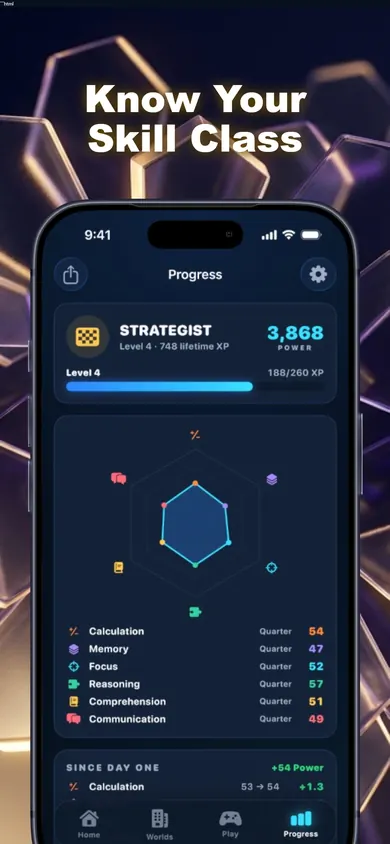
SkillArena says this on its own listing too. Its 1 to 100 ratings describe performance in its own games, not IQ, and not a medical or psychological assessment. We think that is the right promise: a fun, short daily round you can measure honestly.
Where the memory rounds live in SkillArena
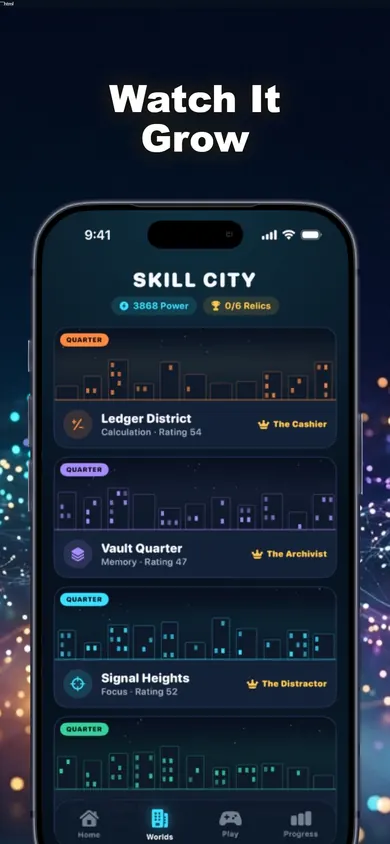
Memory is one of the rated categories. It has its own district, Vault Quarter, guarded by a boss called The Archivist.
Memory game questions
How do I get better at memory games fast?
Stop trying to hold single items. Group them into two or three shapes or rhythms, say the order quietly as it appears, and replay the last round in your head before the next one. Most quick gains come from strategy, not from raw memory changing.
Why do I always forget the end of the pattern?
Working memory holds only a few chunks at once, about four according to Cowan in Behavioral and Brain Sciences (2001). Items past that point push earlier ones out. Chunking the pattern into groups is the usual fix.
Is it cheating to say the pattern out loud?
No. Naming positions ("top left, middle, corner") recruits the verbal side of working memory alongside the visual side. Whisper it if you are on a train.
Do memory games improve your everyday memory?
The evidence says you mostly improve at the games you practise. a large review by Simons and colleagues in Psychological Science in the Public Interest (2016) found good evidence for gains on trained tasks and much weaker evidence for gains in everyday life. Play because you enjoy it.
How long does it take to get better at a memory game?
There is no fixed timeline. Early gains in any new game are partly just learning its rules and rhythm. When progress stalls, changing strategy usually helps more than playing longer.
Does SkillArena have memory games?
Yes. Its thirteen games include repeat-the-pattern and match-the-names rounds, and Memory is one of the rated categories, with its own district in Skill City.
Worked example: chunking an 8-step pattern
Here is a pattern of eight tiles. Read it as eight separate steps and most of us drop the tail. Read it as two shapes and it fits easily.
- Watch the first four steps: top-left, down, down, then right. Call it "an L".
- Watch the rest: top-right corner, then straight down the right edge. Call it "the edge".
- Replay: "L, then edge". Two chunks, with room left for a third if the next round grows.
Two named shapes beat eight loose tiles: that is the whole trick.
When a round goes wrong, replay it in your head once before moving on and ask one question: which chunk broke, the first or the second? That small act of recall turns a miss into practice, the same retrieval idea that helps with names.
Pattern, names or n-back: which memory game trains what
Repeat the pattern
Visual order. Responds well to chunking and naming positions.
Match the names
Linking two pieces of information. Responds well to recall practice.
Card-flip pairs
Where things are. Responds well to a scanning route, row by row.
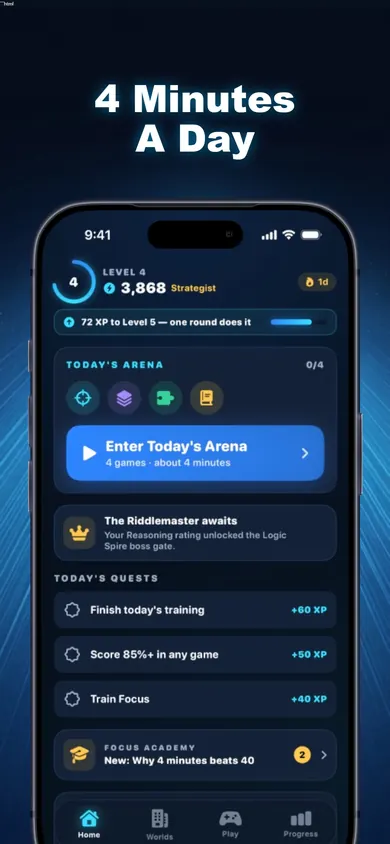
SkillArena's Daily Arena mixes memory with focus, reasoning, numbers, careful reading and clear wording, so a memory round is one of four short games, not a whole session.
Who should pick something else
If you want to remember real things, such as a talk, a language or exam material, a flashcard app with spaced review will serve you better than any game. If memory changes worry you, talk to a doctor rather than a game. SkillArena suits players who enjoy a quick, varied, measurable round and want to watch a rating move.
Try the fixes in today's Arena
Four games, about four minutes, no account. Start on your iPhone with the free download.

Updated November 2026
Related
- SkillArena: four-minute focus training gamesFocus training games for iPhone: four short mixed games a day, adaptive difficulty, 13 games and a Tower to climb. Free, offline, no account.
- How to calculate change in your head (two moves)Calculate change in your head with two moves: cents first, then count up to the next dollar. Try the instant calculator, then a practice round.
- A 24-day advent calendar brain challenge for adults (December 1 to 24)A free advent calendar brain challenge for adults: one short game a day from December 1 to 24, 2026, with a 24-door tracker ring.
- Best brain games for beginners: find your starting modeNew to brain games? Answer three questions and get a starting length, pace and first mode, with a live count of your weekly minutes. Free on iPhone.