 A glossary for people in a hurry
Why do I make mistakes when I rush?
Why do mistakes go up when you rush?
When you rush, you decide on less information, so your error rate climbs; psychologists call this the speed-accuracy tradeoff, and the fix is choosing a slower pace only at the steps where a mistake is expensive. That's the short answer. The glossary below unpacks the nine terms you'll meet if you look into it, in plain English, and the calculator above shows whether slowing down would pay for you.
From the Honest Little Apps team. We make SkillArena, a free skill game for iPhone. Updated November 2026.
OK, give me the words for it.
Glossary: careless mistake terms, explained
- Speed-accuracy tradeoff
- The rule that faster decisions tend to be less accurate and slower ones more accurate. Heitz in Frontiers in Neuroscience (2014) calls it a property of choice behavior that is hard to avoid. You can't escape it, but you can pick where you sit on it.
- Commission error
- Doing something you should have held back on: tapping the decoy, replying-all, paying the wrong invoice. Rushing raises these first, because the hand moves before the check finishes.
- Omission error
- Missing something you should have acted on. Fatigue and boredom tend to cause these more than speed does.
- Go/no-go
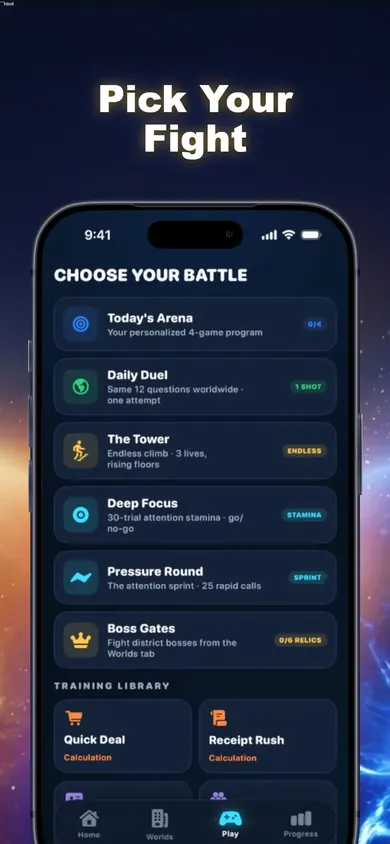
- A task where you respond to one kind of signal and hold back on another. It measures how well you stop a ready response. In SkillArena, Deep Focus is a 30-trial go/no-go game: tap on go, hold on no-go.
- Inhibitory control
- The ability to stop or override a response that's already on its way. It's what fails when you hit send and instantly see the typo.
- Interference
- When something nearby pulls your answer the wrong way, like a familiar word in the wrong place. Eriksen and Eriksen (1974) showed that distractors next to a target slow people down and cause errors.
- Inverse efficiency score
- Average response time divided by the share of answers you got right. It folds speed and accuracy into one number: lower is better. Bruyer and Brysbaert in Psychologica Belgica (2011) caution that it's best used alongside, not instead of, plain speed and error rates.
- Time pressure
- Any deadline that makes you speed up. Short game timers, a queue behind you, a manager waiting. It moves you along the tradeoff toward speed whether you meant to or not.
- Careful reading
- Reading the whole instruction before acting. One of SkillArena's categories is built around it: follow-the-instruction and pick-the-clearest-message games punish the skim.
Speed isn't the enemy; unchosen speed is.
Is this page for me?
Who this is not for
If careless mistakes are new, sudden, or come with memory lapses, headaches or mood changes, a glossary and a game are the wrong next step; see a doctor. If you're looking for an ADHD assessment, SkillArena doesn't do that: its ratings describe how you play its own games and are not an IQ score or a medical, psychological or clinical assessment. And if you already know you're slow but accurate, you probably need the opposite advice: permission to go faster.
This is general information, not medical advice. Talk to your clinician.
A few more questions.
Questions about rushing and careless mistakes
Why do I make more mistakes when I'm in a hurry?
Because faster decisions are made on less information. Researchers call it the speed-accuracy tradeoff: Heitz in Frontiers in Neuroscience (2014) describes it as the tendency for decision speed to covary with decision accuracy. Going faster isn't a character flaw; it's a setting you can turn down.
How do I stop making careless mistakes at work?
Pick the one step where errors are expensive (sending, submitting, paying) and add a deliberate pause there only. Read the instruction once more, check the one number that matters, then act. Everywhere else, keep your speed.
Is making careless mistakes a sign of ADHD?
Not on its own. Everyone makes more errors under time pressure. If careless mistakes are frequent, long-standing and cause problems in several parts of life, talk to a clinician. A game can't tell you either way.
Does slowing down always reduce mistakes?
Usually, up to a point. Once you're accurate, slowing further mostly costs time. The calculator on this page shows where that point is for a given round.
Can a brain game help with rushing?
It can give you a safe place to practice noticing your own pace. SkillArena's Deep Focus is a 30-trial go/no-go game (tap on go, hold on no-go), and the relaxed pace option lengthens timers. Getting better at a game shows improvement at that game, not proof of change elsewhere.
What is a good accuracy to aim for?
There's no universal number. For most everyday tasks, aim for the pace where your errors are rare enough that fixing them doesn't eat the time you saved.
What can't the game do?
Honest limits
- Practising a go/no-go game makes you better at that game. Whether that carries over to your inbox is not something we can promise.
- SkillArena's timers are short by default. That's a feature for practice, but if time pressure is what's hurting you, turn on the relaxed pace option first.
- Every question is generated fresh, so you can't memorise answers; the flip side is that some days' mixes will feel harder than others.
- The calculator on this page is a model of a single round, not a measure of you.
Tell me what that looks like in real life.
A mini story: the 4:55 p.m. invoice
Five minutes before the end of the day, a freelancer sends three invoices in a row. The second goes to the wrong client with the wrong amount. Fixing it takes twenty minutes and an awkward email. Every invoice had been typed fast and checked fast, because the day was nearly done.
The change that worked wasn't "be more careful" all day. It was one deliberate pause: before pressing send, read the client name and the total out loud. Two seconds, at the one step where an error costs twenty minutes. In the terms above, that's moving along the speed-accuracy tradeoff only where commission errors are expensive.
How does SkillArena fit in?
Comparison strip: rushing vs pacing, in the game
| Rushing | Pacing | |
|---|---|---|
| Deep Focus | Tapping on no-go trials | Holding back until it's a go |
| Follow instructions | Answering the question you expected | Reading the one you got |
| Estimate totals | Adding every cent | Rounding, then checking |
| Timer | Default, short | Relaxed pace option for longer timers |
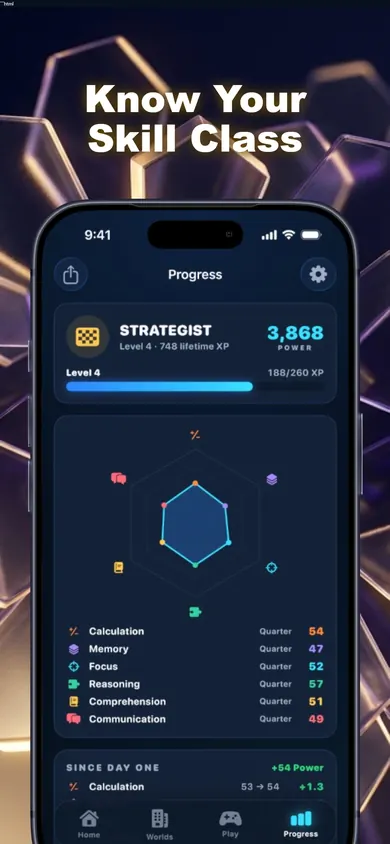
One design decision we made: if you leave the app mid-round, the timer pauses until you come back, so a phone call doesn't count as a mistake.
Where do I start?
Start on your iPhone
Play Today's Arena once at your normal speed, then once at a steady pace, and notice the difference. Start on your iPhone; it's free, with no ads and no account.

Related
- SkillArena: four-minute focus training gamesFocus training games for iPhone: four short mixed games a day, adaptive difficulty, 13 games and a Tower to climb. Free, offline, no account.
- Best brain games for beginners: find your starting modeNew to brain games? Answer three questions and get a starting length, pace and first mode, with a live count of your weekly minutes. Free on iPhone.
- Brain games for teens over winter break: a parent guideA parent guide to brain games for teens over winter break 2026: what SkillArena shows your teen, a 16-day mode plan, and honest limits.
- How to calculate change in your head (two moves)Calculate change in your head with two moves: cents first, then count up to the next dollar. Try the instant calculator, then a practice round.